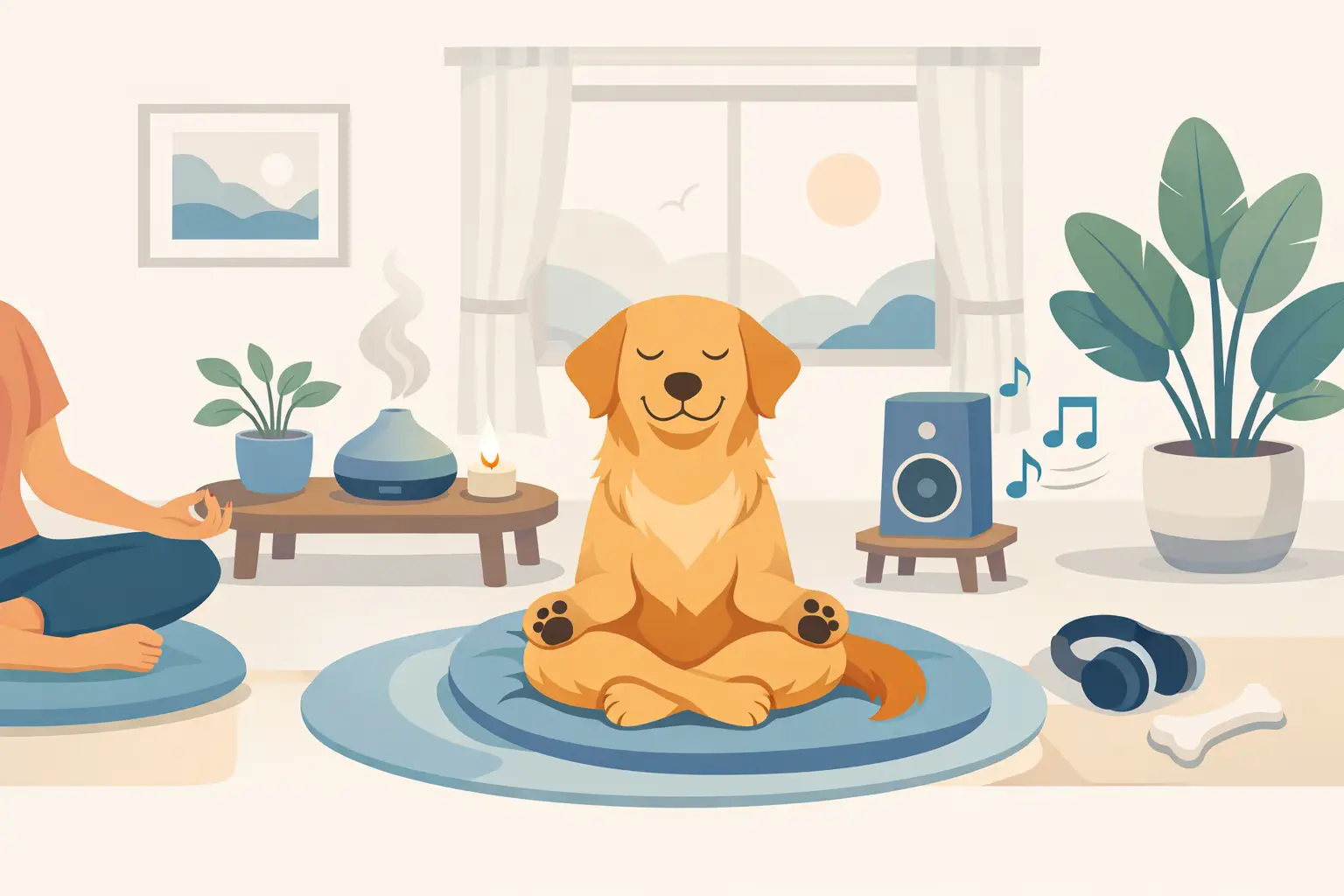
When your dog hits full volume the second the doorbell rings, spins before walks, or paces through the evening like they cannot land, the problem usually is not a lack of exercise alone. It is often a lack of structure around arousal. A good dog calmness routine at home gives your dog a predictable way to settle before excitement tips into chaos.
That matters because most household behavior problems are not random. They follow a pattern. Your dog notices a trigger, reacts fast, and keeps rehearsing that reaction until it becomes the default. If you want calmer greetings, quieter windows, smoother walks, and less end-of-day overstimulation, the answer is not constant correction. It is a repeatable routine your dog can practice every day.
Why a dog calmness routine at home matters
Owners often wait to work on calmness until a problem is already happening. The barking starts, the leash comes out, guests arrive, and everyone is behind. At that point, your dog is already over threshold, which means learning drops and impulsive behavior rises.
A home routine changes the starting point. Instead of asking your dog to magically calm down in the hardest moment, you build the skill in smaller, lower-pressure moments first. That is where real progress happens.
This is also why random tips can feel disappointing. One video tells you to ignore jumping. Another says use more treats. Another says tire your dog out. None of those ideas are always wrong, but without a consistent pattern, your dog never gets a clear picture of what to do instead.
Calmness is not a personality trait some dogs have and others do not. It is a trainable state supported by repetition, timing, and environment. Some dogs need more reps than others. Some need shorter sessions. But nearly every dog benefits from a stable routine that lowers overall arousal at home.
The core of a calmness routine: Notice, Reset, Reward, Release
A practical dog calmness routine at home should be simple enough to use when real life is happening. That is why a four-step loop works well: Notice, Reset, Reward, Release.
Notice means you catch the moment before your dog fully escalates. That might be ears forward at the window, pacing when you pick up keys, or body tension when someone walks past the house. If you only step in once barking or lunging is already underway, you are late.
Reset means you interrupt the buildup with a calm, familiar action. Depending on the dog, that could be moving away from the window, guiding to a mat, pausing at a doorway, or waiting quietly before the leash goes on. The point is not punishment. The point is helping your dog come back under threshold.
Reward means you reinforce the calmer choice right when it happens. A breath, softer eyes, four paws on the floor, a pause instead of a bark - these are the moments that need payment. Dogs repeat what works.
Release means the routine ends clearly. Your dog is not trapped in an endless state of restraint. They learn that calm behavior leads somewhere. Sometimes that means going outside, greeting a guest with guidance, or simply being free to move again.
This loop is effective because it is realistic. It fits normal household life better than long training blocks most owners cannot sustain.
What your daily routine should actually look like
The best routine is short enough to repeat and clear enough to measure. For most busy households, that means weaving calmness work into moments that already happen every day rather than adding an hour of extra training.
Start with one or two predictable pressure points. Pre-walk excitement is a strong choice because it happens often and owners can usually control the setup. Doorways, meal prep, window triggers, and evening restlessness are also common starting points.
For example, before a walk, do not rush from leash sight to front door. Pick up the leash and watch your dog. If excitement spikes immediately, pause. Wait for a softer body, a sit if that is already known, or even two seconds of stillness. Then reward. If your dog surges again, reset and repeat. Once calm returns, continue. Over time, your dog learns that frantic behavior delays access while calmer behavior moves things forward.
The same pattern works at the doorbell with a few adjustments. You may need to lower intensity first by practicing with low-level knocks, recorded sounds, or a helper who can control timing. If the real doorbell sends your dog into a full-body spiral, start smaller. Good training meets the dog you have today, not the dog you wish was already finished.
Evening overstimulation often needs a different kind of routine. This is less about one trigger and more about helping your dog downshift after a day of activity, noise, and transitions. In that case, a calmness routine might include a quiet leash walk, a few minutes on a settle mat, a chew, reduced household chaos, and reward for choosing stillness. Not every dog needs the same evening plan. Younger, high-drive, or more reactive dogs usually need more intentional decompression than easygoing dogs.
Common mistakes that keep dogs wired at home
One mistake is only rewarding obedience and missing calm behavior that happens on its own. If your dog lies down quietly for ten seconds and nobody notices, you lost a useful rep. Calmness grows when owners mark and reward it consistently.
Another mistake is asking for too much duration too soon. Owners often want a dog to settle for thirty minutes when the dog cannot yet settle for thirty seconds. Build in layers. First reward the pause. Then reward staying. Then increase distractions. Duration is earned, not demanded.
The third mistake is inconsistency around release points. If sometimes barking at the window works, sometimes jumping gets attention, and sometimes pulling gets the walk started faster, your dog gets mixed feedback. Behavior becomes harder to change when the rules move around.
There is also a scheduling issue many owners miss. Dogs who bounce from trigger to trigger all day without enough recovery time often look stubborn when they are actually overloaded. If your dog has a hard morning walk, loud package deliveries, fence-line reactions, and a chaotic evening greeting, the nervous system may never fully settle. In those cases, progress comes faster when you reduce total stimulation while teaching the routine.
How to tell if the routine is working
Progress is not always dramatic at first. In household training, the early wins are usually smaller and more meaningful than people expect.
Maybe your dog still notices the window trigger but recovers in ten seconds instead of two minutes. Maybe leash prep used to cause spinning and barking, and now you get one burst followed by a quick reset. Maybe your dog still greets guests with excitement but can return to the floor faster. Those are real changes.
Track observable behavior instead of relying on memory. Count barks. Measure recovery time. Note how long your dog can hold a settle. Write down which triggers caused the biggest reaction that day. Clarity helps you stay objective, especially when you are tired and it feels like nothing is changing.
This is also where owners benefit from a system rather than isolated advice. A structured approach like Rubyjo K9's calm training framework keeps you from changing methods every three days. Dogs do better when the process stays stable long enough to teach something.
When to make the routine easier
If your dog is failing every rep, the routine is too hard. That does not mean your dog is incapable. It usually means the environment, timing, or expectations need adjusting.
Make the trigger smaller. Increase distance. Shorten the session. Lower the duration. Reward earlier. Use fewer steps. Calm training should feel repeatable, not like a daily test your dog keeps failing.
Owners sometimes worry that making things easier is letting the dog get away with something. It is not. It is good training. You are setting up a successful rep so the nervous system can practice regulation instead of rehearsal of chaos.
Building a home that supports calmness
Training matters, but so does the environment around it. A dog cannot practice calmness well in a space full of unmanaged triggers. If window barking is constant, block visual access during the training phase. If guest arrivals are explosive, create a clear station or entry routine before people walk in. If evening behavior falls apart when the whole family is active, build one quiet transition into the schedule.
This is not about wrapping your dog in cotton. It is about reducing unnecessary rehearsals while the new habit is still weak. Once your dog has more skill, you can gradually ask for calmness in harder, messier versions of real life.
A good routine does not need to be impressive. It needs to be repeatable on Tuesday when you are busy, on Friday when you are tired, and on Sunday when guests show up. Calm dogs are often built through ordinary reps, not heroic training sessions.
If your house feels noisy, jumpy, and hard to manage right now, start smaller than you think. Pick one trigger, use one routine, and stay with it long enough for your dog to understand the pattern. Calmness is built in the return, one reset at a time.
Safety note
Safety note: if your dog shows aggression, intense fear, bite risk, pain, sudden behavior change, or medical concerns, contact a qualified professional or veterinarian before pushing the routine harder. This article is educational and is not a substitute for individualized behavior or veterinary care.