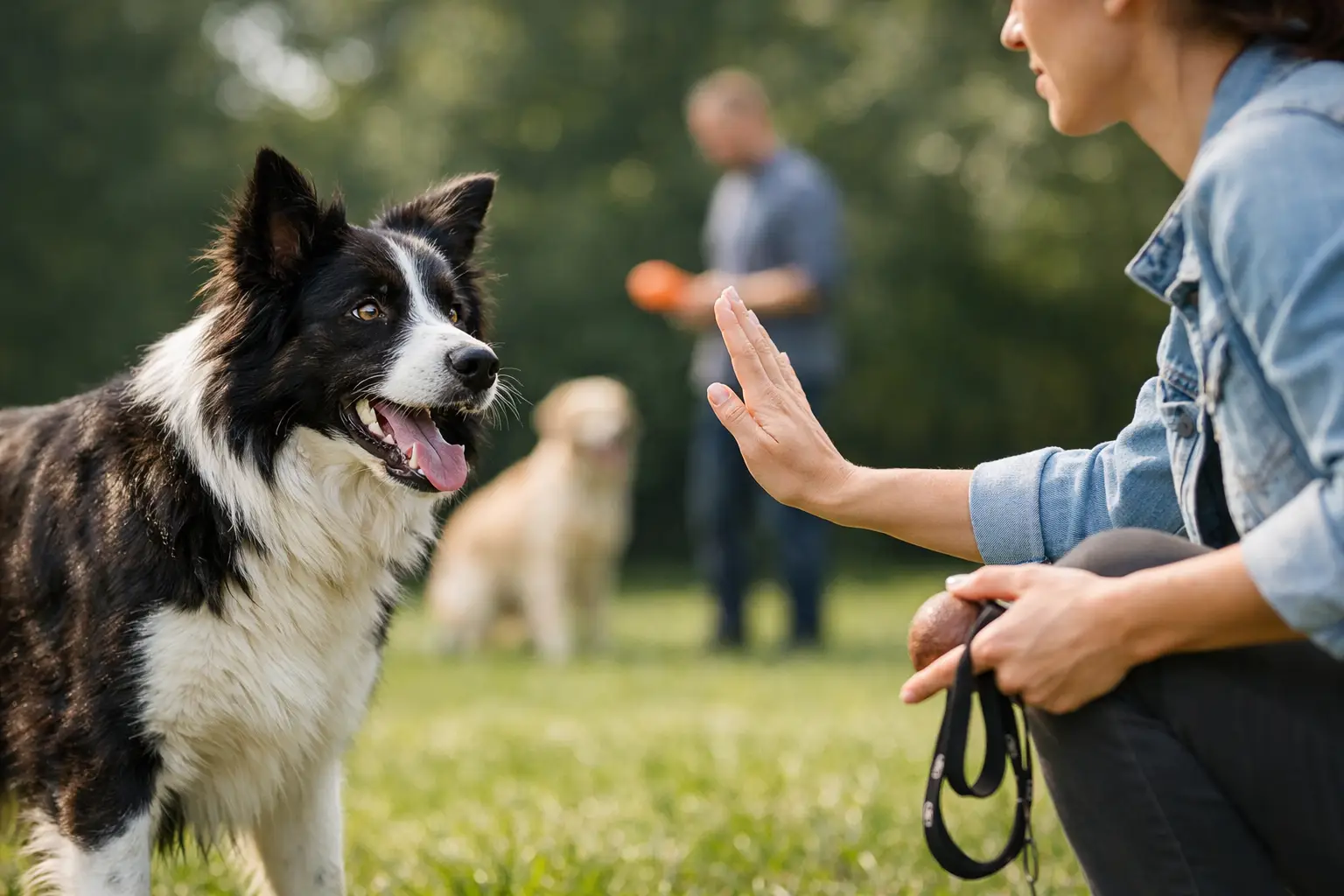
When your dog loses it before the leash even clips on, the problem usually is not disobedience. It is arousal. A good guide to dog arousal management starts there, because barking, jumping, spinning, mouthing, door rushing, and post-walk chaos are often signs of a nervous system that is too activated to make good choices.
That matters for everyday life. An over-aroused dog is harder to walk, harder to redirect, and slower to recover after a trigger. Many owners keep searching for one command that will fix it, but arousal is rarely solved by a single cue. It improves when the dog learns a repeatable pattern for noticing pressure, settling, and returning to calm.
What dog arousal really means
Arousal is your dog's level of activation. That activation can come from excitement, frustration, stress, anticipation, or environmental pressure. It is not always negative. A dog can be happily aroused before a game of fetch, but if that activation climbs too high, behavior starts to fall apart.
This is why dogs can look "fine" one minute and explode the next. They are often stacking stimulation long before the obvious outburst happens. The doorbell rings, someone walks past the window, dinner is late, the leash comes out, and then a guest enters. By that point, the body is already primed.
Owners often miss this because they are watching for bad behavior instead of early signs. In real life, arousal usually shows up first as pacing, hard staring, faster movement, whining, inability to take food, grabbing the leash, scanning the room, or repeatedly checking the trigger. Those are the moments that matter most.
Why punishment does not solve overstimulation
If a dog is already over threshold, corrections may interrupt the behavior for a moment, but they do not teach regulation. In some dogs, they add more pressure and actually increase tension. That is why a dog may stop barking briefly, then come back louder, faster, and less reachable.
Management is not the same as letting things slide. It means you are reducing unnecessary activation while teaching the dog what to do instead. Calm behavior is a skill. Recovery is a skill. Waiting is a skill. Dogs do not build those skills in the middle of full chaos without structure.
A practical guide to dog arousal management at home
The goal is not to create a perfectly quiet dog. The goal is to lower the peaks, shorten recovery time, and give your dog a clear path back to control. For most households, that starts with a simple loop you can repeat every day: notice, reset, reward, release.
Notice the early signs
Notice means catching the dog before the full spiral. That could be the second your dog hears keys, sees the leash, spots movement at the window, or starts revving when guests arrive. If you wait until barking turns frantic or jumping turns wild, you are working much harder than you need to.
This step sounds basic, but it is where most progress begins. Busy owners often move too fast through predictable trigger moments. Slow down just enough to identify the first change in breathing, posture, or intensity. That is your entry point.
Reset the nervous system
Reset does not mean demanding a perfect down-stay in the hardest moment. It means interrupting the upward climb and guiding the dog back to a manageable state. Depending on the dog, that might be a few steps away from the window, a pause before opening the door, a leash reset at the front hall, or a food scatter that changes the dog's body from upright and scanning to sniffing and thinking.
The best reset is the one your dog can actually do. A common mistake is choosing a behavior that is too advanced for the level of arousal. If your dog cannot hold a sit when the doorbell rings, ask for a simpler reset first, like orienting back to you, moving behind a gate, or taking a breath and eating three pieces of food in a row.
Reward the recovery
Many owners reward compliance but forget to reward regulation. The reward should mark the moment your dog starts making a better choice - softer body, turning away from the trigger, four paws on the floor, a quieter mouth, a brief pause. That is the behavior pattern you want to grow.
Rewards do not have to mean constant bribery. They are information. They tell the dog, "That right there worked." Over time, the dog gets faster at finding the calm path because it has been reinforced clearly and consistently.
Release with intention
Release matters because dogs need to know when the difficult part is over. If every pause leads to more pressure and no clear endpoint, frustration builds. A release can mean going outside once the leash routine is calm, greeting a guest after feet stay grounded, or returning to normal activity after a successful reset.
This is where balance matters. We are not suppressing the dog. We are teaching the dog that calm behavior is what moves life forward.
The biggest household trigger patterns
Most arousal problems follow predictable routines. Pre-walk chaos often starts when the dog hears shoes hit the floor or sees you reach for the leash. Doorbell barking usually builds from anticipation, territorial behavior, and lack of a rehearsed alternative. Evening overstimulation often comes from trigger stacking across the whole day - not enough decompression, too much environmental input, and no clear off-switch.
That is why random tips fail. If you only react to the explosion, you miss the pattern that created it. Household progress comes from changing the routine before the outburst happens.
For example, if your dog spins and screams before walks, do not make the walk the reward for frantic behavior. Pause the routine. Pick up the leash, notice the dog's response, reset if needed, reward the calmer moment, then continue. If arousal spikes again, stop again. Yes, it takes longer at first. But this is how the dog learns that access comes through regulation, not escalation.
The same principle applies to guests. If your dog practices explosive greetings every weekend, the excitement itself becomes rehearsed. Use distance, barriers, and short reps so the dog can succeed before direct interaction. Calm greeting skills are built in layers.
It depends on the dog in front of you
Not every high-energy dog has the same issue. Some dogs are excited and social. Some are frustrated because they want access. Some are anxious and scanning for threats. Some are tired, under-slept, and functioning poorly by evening. The outward behavior can look similar, but the training choices may differ.
That is why arousal management should not be reduced to "just exercise them more." More activity helps some dogs, but for others it creates an even fitter athlete with no off-switch. Dogs need appropriate outlets, but they also need practice recovering, waiting, and settling after stimulation.
A realistic plan usually includes both movement and decompression, both training and management. Baby gates, visual barriers, calmer transitions, food-based reset work, and shorter sessions are not shortcuts. They are often the reason training becomes possible.
How to measure progress without guessing
Arousal work can feel slow if you only judge success by whether the dog ever reacts. A better measure is intensity, duration, and recovery. Is the barking shorter? Is the jumping less frantic? Can your dog eat sooner after the trigger? Can you interrupt earlier? Does your dog return to baseline faster?
Those are real wins. They tell you the nervous system is becoming more flexible, even before the behavior looks perfect.
This is also where consistency beats intensity. Five short, repeatable reps inside normal life are more useful than one long session you cannot maintain. If you are overwhelmed, choose one trigger pattern and train that well. Front door greetings, pre-walk arousal, and window barking are common starting points because they happen often enough to practice.
When owners get stuck
Most people do not fail because they do not care. They get stuck because they are trying to remember too many steps in the heat of the moment. That is why owner-friendly systems work better than scattered advice. You need one routine that is simple enough to use when the dog is loud, the kids are moving, dinner is half done, and someone just rang the bell.
At Rubyjo K9, that is exactly why the training is built around short, repeatable routines instead of endless theory. The calmer household most owners want is usually not the result of doing more. It comes from doing the same clear sequence often enough that both you and your dog know what happens next.
If your dog gets too big, too loud, or too wild in predictable moments, start smaller than you think. Catch the first sign, reset early, reward recovery, and let calm behavior open the next door. That is how steadier dogs are built - one ordinary household moment at a time.
Safety note
Safety note: if your dog shows aggression, intense fear, bite risk, pain, sudden behavior change, or medical concerns, contact a qualified professional or veterinarian before pushing the routine harder. This article is educational and is not a substitute for individualized behavior or veterinary care.