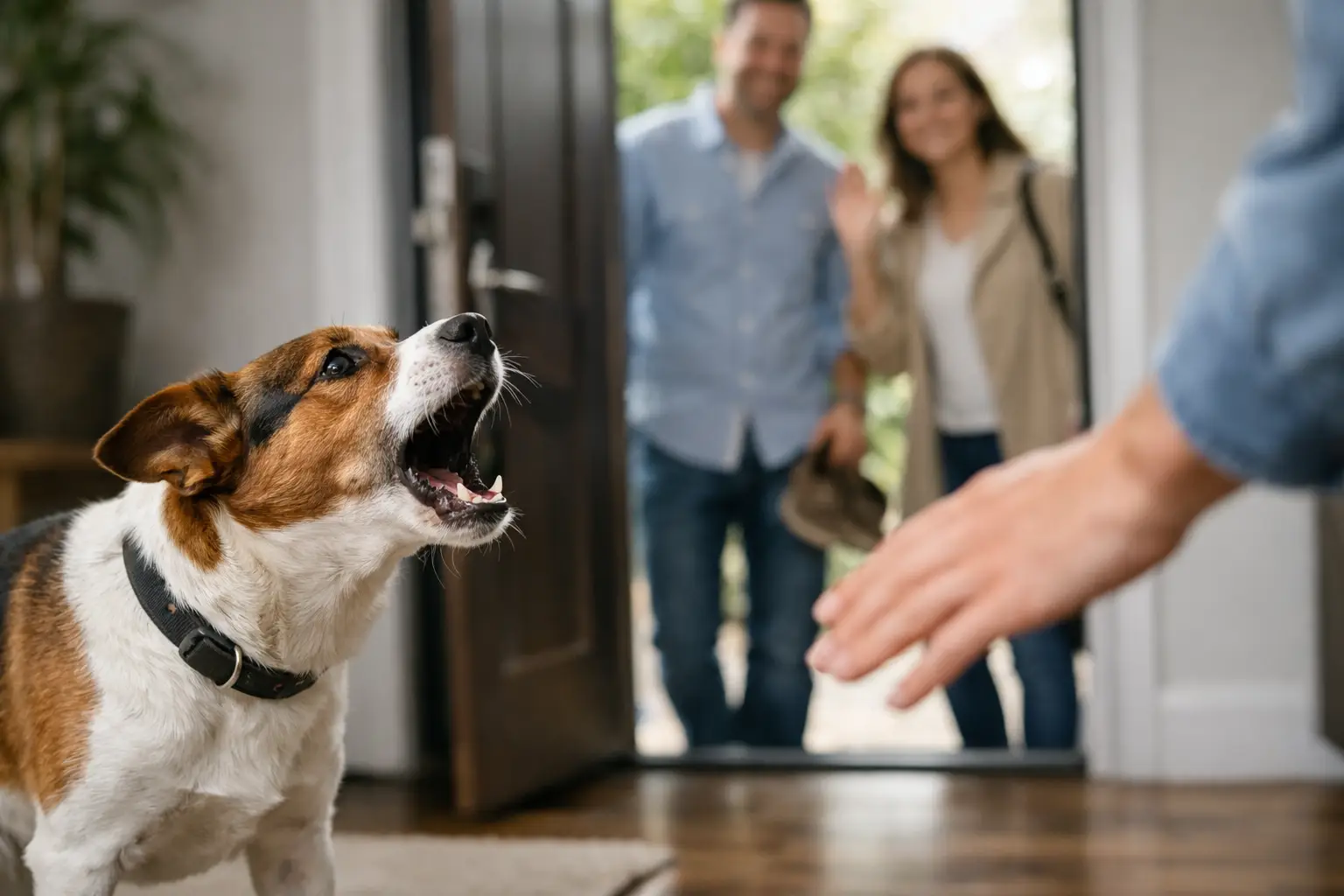
The barking usually starts before anyone is even inside. Your dog hears the car door, the footsteps, the knock, and suddenly the whole house is on edge. If you want to stop dog barking at visitors, the fix is not yelling over the noise or hoping your dog will “get used to it.” The real work is teaching your dog what to do before, during, and after the door opens.
That matters because visitor barking is rarely just about the person at the door. It is often a full-body arousal spike. Your dog notices a trigger, escalates fast, and rehearses the same pattern every time. Barking, rushing the entry, jumping, circling, and struggling to settle usually travel together. If you only try to silence the bark, you miss the bigger loop driving the behavior.
Why dogs bark at visitors in the first place
Some dogs bark because they are excited. Some bark because they are worried. Many are a mix of both. The doorbell predicts intensity, movement, voices, eye contact, and a break in routine. For an excitable or easily overstimulated dog, that can be more than they know how to handle.
This is why punishment often backfires. If your dog is alarmed, harsh corrections add pressure to an already stressed moment. If your dog is overexcited, your big reaction can become part of the event and add even more energy. Either way, the dog is not learning calm behavior. They are just having a louder experience.
A better question is this: what behavior do you want instead? Quiet feet on the floor. Distance from the doorway. A familiar station. A chance to recover before greeting. That kind of clarity changes training from “stop doing that” to “here is your job when people arrive.”
To stop dog barking at visitors, start before the knock
Most owners begin training at the exact moment things fall apart. That is understandable, but it is also the hardest place to teach. If your dog is already sprinting, barking, and ricocheting off the front window, they are too activated to learn much.
Start by separating the visitor routine into smaller pieces. The sound of the doorbell, movement toward the door, seeing a person through the window, and greeting at close range are different layers. Train them one at a time.
Pick one calm location a few steps away from the entry. A mat, bed, or rug works well. This is not a magical spot. It is simply a clear target that helps your dog move away from the door and into a repeatable pattern. Practice sending your dog there when nothing is happening. Reward calm body language, not frantic compliance. You are looking for softer muscles, slower breathing, and the ability to pause.
Then add low-level rehearsals. Touch the doorknob. Walk toward the entry. Open and close the door without anyone there. Play a knock sound softly on your phone if needed. Each time your dog notices the trigger, guide them back to the mat, reset, and reward the calmer choice.
This is where a simple pattern helps. Notice the trigger, reset the dog back to position, reward the behavior you want, then release when calm. That sequence is easier to repeat under pressure than a pile of random advice.
What to do in the moment when guests arrive
Real-life visitor training should be boring on purpose. If your current routine is chaotic, your first goal is not a perfect greeting. Your first goal is control and recovery.
Before opening the door, create distance. Use a leash if you need it. If your dog has a history of charging the entry, put management in place before the guest arrives. A leash, gate, closed interior door, or tether can prevent a bad rehearsal while you teach better skills. Management is not failure. It is how you keep the situation safe and trainable.
Ask for the known station behavior away from the door. If your dog can hold it for two seconds, reward that. Then build to five, then ten. If barking starts, do not argue with it. Reset the dog back to the station as calmly as you can. The less emotional you are, the easier it is for your dog to recover.
Keep the guest out of the training at first. Most people want to help by talking to the dog, leaning over, or reaching out. For a dog who is already over threshold, that usually makes things worse. Tell visitors ahead of time to ignore your dog completely until invited otherwise. No eye contact, no baby talk, no petting.
If your dog cannot stay under control with the person entering, increase distance and lower expectations. That may mean the dog remains behind a gate while the guest sits down. It may mean there is no greeting at all for the first few sessions. Calm exposure is more useful than a forced interaction.
The mistake that keeps visitor barking going
A common pattern looks like this: the dog barks wildly, the guest comes in anyway, everyone talks loudly, the dog jumps, then eventually settles. From the dog’s perspective, barking and rushing the entry are part of the script that successfully brings the person inside.
That does not mean your dog is being manipulative. It means the whole sequence has been rehearsed enough to feel automatic.
To change that, you need a different script. Barking should not be the behavior that gets your dog closer to the visitor. Calm behavior should. Even a small release matters. A pause in barking, four paws on the floor, and a brief check-in with you can earn a reward and a little more freedom. Over time, your dog learns that self-control opens access.
This is also why timing matters. If you wait until your dog is fully exploding, you are always late. Catch the first sign of loading. The ears change, the body leans forward, the breathing gets quicker, the eyes lock on the door. That is the moment to interrupt the loop early.
A realistic training plan for busy households
You do not need hour-long sessions to stop dog barking at visitors. You need short, repeatable reps that fit normal life. Five minutes once or twice a day is enough to build the pattern if you stay consistent.
Spend a few days teaching the station behavior away from the door. Then spend a few days adding door movement without visitors. After that, recruit one calm friend for planned practice. Do not start with the most exciting guest your dog knows. Pick someone who can follow instructions and keep their energy neutral.
Measure progress by recovery, not perfection. Is the barking shorter than last week? Can your dog move to the mat faster? Can they stay calmer while the guest sits down? Can they disengage and settle sooner after the door opens? Those are meaningful wins.
For many households, the hardest part is not training the dog. It is remembering what to do when life is busy. That is why a clear routine matters more than collecting more tips. Rubyjo K9 teaches this kind of household behavior change through short daily reps because consistency beats intensity almost every time.
When greetings should wait
Not every dog needs to greet every visitor. That is an important mindset shift.
If your dog is anxious, highly reactive, or still in early training, a no-greeting plan may be the right plan for now. Your dog can stay on a mat, behind a gate, or in another room with a calming activity while guests settle in. Later, if the dog is regulated and showing loose, social body language, you can decide whether a brief greeting makes sense.
There is no prize for rushing this. Owners often feel pressure to prove their dog is friendly, but pushing contact too soon can keep the whole problem alive. Calm first. Social second.
What success actually looks like
Success does not always mean silence the second the doorbell rings. For some dogs, the first big improvement is one or two barks instead of twenty. For others, it is staying on the mat while the guest enters. For many, it is learning how to recover instead of spiraling.
That may sound modest, but it is how durable behavior change works. You are building emotional control, not teaching a trick. The dog who can notice a visitor, reset, and settle is learning a skill that carries into other parts of the day too.
If your house has been loud and stressful around arrivals, do not underestimate what a calmer routine gives back to you. Less tension at the door. Fewer apologies to guests. More confidence that you can handle the moment without bracing for chaos.
Start small. Pick one setup, one station, and one version of the routine you can actually repeat this week. Your dog does not need a perfect performance. They need a clear pattern, enough support to stay under control, and your consistency long enough for calm to become familiar.
Safety note
Safety note: if your dog shows aggression, intense fear, bite risk, pain, sudden behavior change, or medical concerns, contact a qualified professional or veterinarian before pushing the routine harder. This article is educational and is not a substitute for individualized behavior or veterinary care.