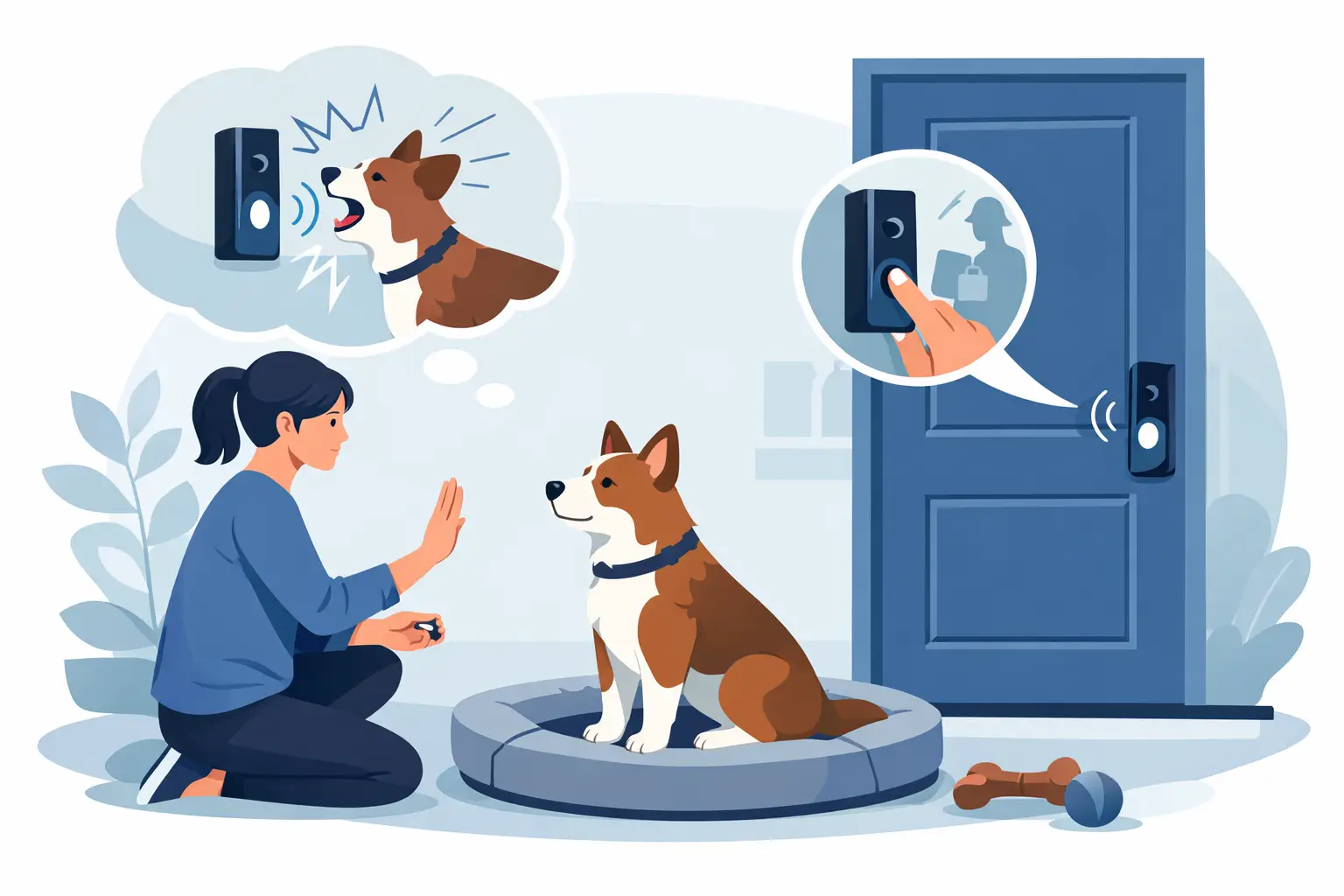
The doorbell rings, your dog explodes, and the whole house feels tense before you even reach the handle. If you are trying to figure out how to stop doorbell barking, the goal is not to silence your dog by force. The goal is to change the pattern so the bell stops launching your dog into a full-body stress response.
Most owners get stuck because they treat doorbell barking like a bad habit instead of an arousal loop. The sound happens, the dog rushes, barks, rehearses the same reaction, and then eventually comes down long after the moment has passed. If that sequence repeats every day, the behavior gets stronger, faster, and harder to interrupt.
Why doorbell barking gets so intense
For many dogs, the doorbell is not just a sound. It predicts movement, strangers, excitement, uncertainty, and a burst of energy from the humans in the house. You stand up quickly, walk to the door, speak differently, and open access to a new person. From your dog’s point of view, that is a big event.
Some dogs bark because they are alarmed. Some bark because they are overexcited. Many are a mix of both. That distinction matters because a fearful dog may need more distance and gentler exposure, while a social but impulsive dog may need stronger work on slowing down and holding position. Either way, yelling over the barking usually adds more intensity, not less.
The hard part is that doorbell barking is self-reinforcing. Barking feels active. Charging the door feels purposeful. Even if the guest eventually comes in and the dog settles, the brain still rehearsed the launch. That is why random correction in the moment rarely creates lasting change.
How to stop doorbell barking with a repeatable routine
The fastest way to make progress is to stop treating every ring like a test of obedience and start treating it like a training loop. Your dog needs a predictable job before, during, and after the sound.
A simple framework is Notice -> Reset -> Reward -> Release.
Notice means your dog hears the trigger and starts to respond. Reset means you interrupt the rush with a trained action such as moving to a mat, backing away from the door, or orienting to you. Reward means calm behavior pays well and quickly. Release means your dog does not stay trapped in tension forever. They get clear information about when the exercise is done.
This works because it gives your dog something structured to do instead of just something not to do.
Start below full intensity
If your dog loses their mind at a real doorbell, do not begin with surprise guest arrivals. Start with a lower-level version you can control. You might use a doorbell recording at low volume, a knock sound on your phone, or a helper who can ring once and wait. Controlled practice matters because you cannot teach new behavior when your dog is already way over threshold.
At the first sound, mark the moment your dog notices it, then guide them into the reset behavior. That might be walking with you to a mat or turning to you for a treat scatter away from the door. Reward generously while your dog is still thinking, not after they have already spiraled.
Keep these reps short. One ring, one reset, one reward, then a break. The point is to build a new sequence your dog can actually repeat.
Pick one reset behavior and stay consistent
Owners often slow progress by switching strategies every few days. One day it is place training, the next day it is sit and stay, then it is holding the collar, then it is sending the dog to another room. Consistency helps the dog predict what comes next.
The best reset behavior is the one you can use in real life. For many homes, a mat station several feet from the door works well. It creates distance, gives the dog a target, and is easy to reward. In other homes, especially with very intense door charging, moving behind a baby gate or into a nearby room may be the safer starting point.
What matters is that the behavior is simple, repeatable, and practiced when the house is quiet. Do not expect a brand-new doorbell routine to work if your dog only sees the mat during the most exciting moment of the day.
What your training sessions should look like
Training does not need to be long. It does need to be clean.
Set up 5 to 10 repetitions with a helper or controlled sound. Ring once. Pause. Ask for the reset. Reward calm. End the rep. If your dog barks once but can still respond, you are in workable territory. If your dog is frantic, ignoring food, spinning, or racing back to the door, the setup is too hard.
That is where many owners accidentally rehearse the exact behavior they want to remove. More reps at full chaos are not better. Easier reps are better.
Reward early, not late
A common mistake is waiting for complete silence before rewarding. That sounds logical, but in practice it often means the dog has already spent ten seconds barking, lunging, and escalating before you step in. Reward the first usable moment. That could be eye contact, a turn away from the door, four paws on the mat, or even a half-second pause in vocalizing if your dog is just starting out.
You are not rewarding the barking. You are capturing recovery.
As your dog improves, you can ask for more duration and more composure before the reward arrives.
Train the release too
Many dogs can hold it together for a few seconds and then erupt again when the guest enters. That usually means the owner trained the reset but skipped the release. After the reward, tell your dog what happens next. Maybe they stay on the mat while the guest comes in. Maybe they are released to greet only when calm. Maybe they remain behind a gate until their body softens.
Calm behavior needs a full path, not just a single checkpoint.
Real-life management while your dog is learning
If you want to know how to stop doorbell barking faster, reduce the number of uncontrolled explosions. Training builds skill, but management protects the progress.
That may mean muting the doorbell for a few weeks and asking visitors to text. It may mean using a sign on the door, pre-staging treats by the entry, or keeping your dog on leash when you know someone is about to arrive. These are not shortcuts. They are part of behavior change.
The trade-off is simple. Management is not the final answer, but without it, your dog may keep rehearsing the same frantic response often enough to cancel out your training sessions.
What not to do
Punishing the barking can suppress noise in some dogs, but it often leaves the underlying arousal untouched. The dog may still feel just as activated, just with more conflict layered on top. That is especially risky with dogs who are already anxious about strangers or sudden sounds.
It also helps to avoid repeated cueing. If you say place, place, place, place while your dog is charging the door, the cue starts to lose meaning. Say it once when your dog can still respond. If they cannot respond, lower the difficulty next time.
And try not to practice only during actual guest arrivals. Real guests are the final exam. Most dogs need several weeks of low-stakes rehearsal first.
When progress feels slow
Doorbell work improves in layers. First your dog may bark less intensely. Then recovery gets faster. Then they start turning to you instead of sprinting to the door. Then one day the bell rings and the reaction is smaller than you expected.
That kind of progress is easy to miss if you are only looking for perfect silence. A better question is this: Is my dog recovering faster, responding sooner, and needing less help than last week?
If the answer is yes, the plan is working.
Some dogs need extra support because the issue is not just the bell. Window barking, hallway sounds, guest anxiety, and general evening overstimulation can all feed into the same pattern. In those cases, the doorbell is just the loudest symptom. The training still works, but the wider household routine may need to get calmer too.
At Rubyjo K9, this is why short daily reps matter more than occasional big efforts. Calm behavior is built through repetition your dog can actually succeed with.
A practical doorbell barking plan for this week
For the next seven days, keep it simple. Choose one reset behavior. Practice it without the bell first. Then add a low-level sound for a few controlled reps each day. Reward the first signs of recovery. Use management during real arrivals so your dog does not keep rehearsing the old pattern.
Do not look for dramatic transformation after one session. Look for cleaner reps, quicker recovery, and less chaos at the front door. That is how lasting change usually starts.
Your dog does not need louder corrections or a more complicated plan. They need a calmer pattern they can repeat often enough for it to become familiar.
Safety note
Safety note: if your dog shows aggression, intense fear, bite risk, pain, sudden behavior change, or medical concerns, contact a qualified professional or veterinarian before pushing the routine harder. This article is educational and is not a substitute for individualized behavior or veterinary care.