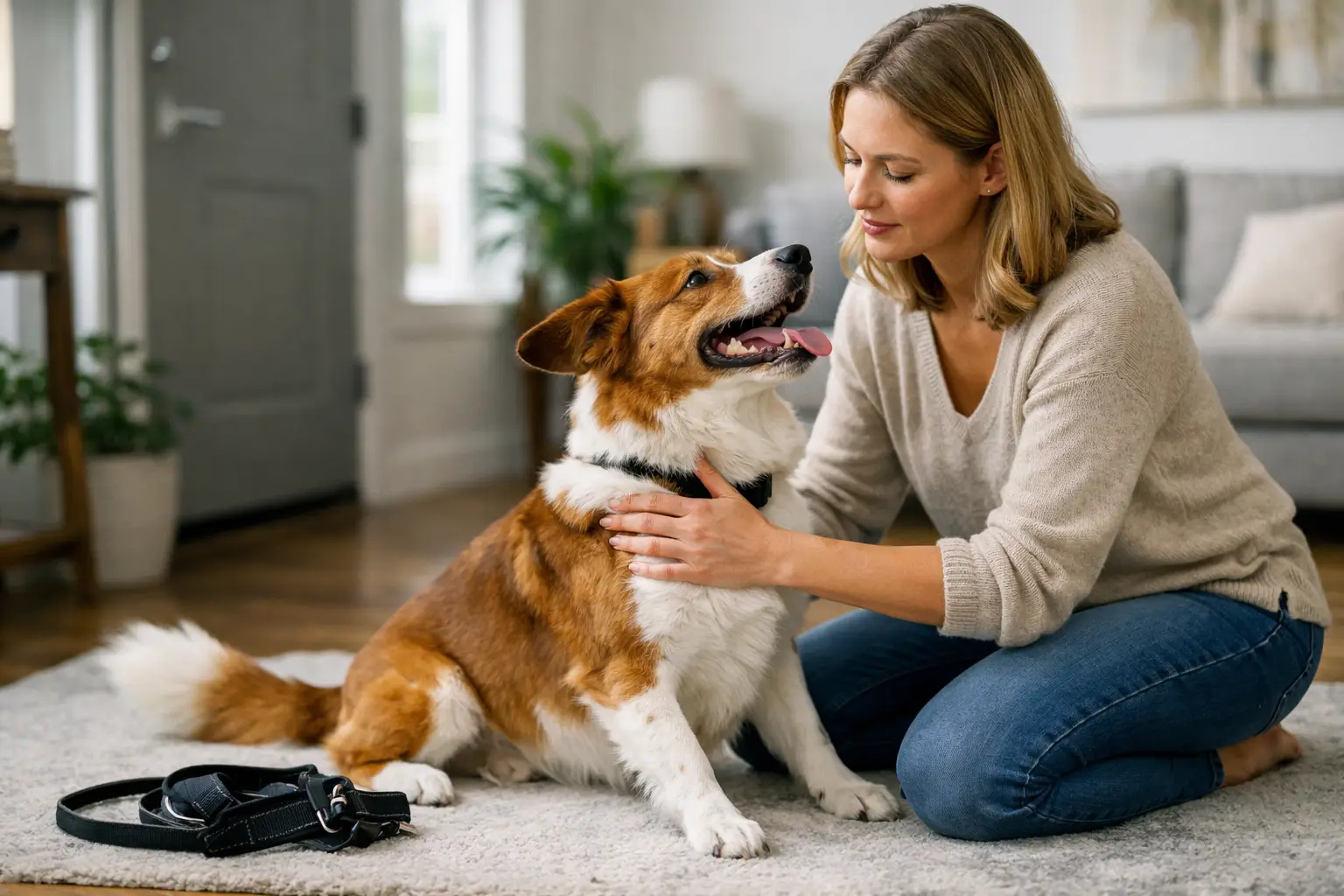
The leash comes out, and your dog goes from resting to ricocheting through the house. They bark, spin, jump, grab the leash, or race to the door before you have found your shoes. If you want to reduce dog pre walk frenzy, do not start by asking for a perfect sit in the middle of the explosion. Start earlier, lower the intensity, and build one predictable routine your dog can repeat every day.
Pre-walk excitement is not a character flaw or proof that your dog is being stubborn. For many dogs, it is a learned anticipation pattern: leash appears, door opens, the exciting outside world happens. The goal is not to make your dog dull or suppress their enjoyment of a walk. The goal is to teach them that calm behavior, not frantic behavior, moves the routine forward.
Why Pre-Walk Frenzy Gets Stronger
Dogs repeat what works. If barking, bouncing, and charging the door still lead to a walk, those behaviors have been rehearsed hundreds of times. Even when you occasionally pause or say “wait,” the overall pattern may still be clear to the dog: excitement eventually gets me outside.
Morning schedules can make this worse. You are watching the clock, packing lunches, answering messages, or trying to get everyone out the door. It is understandable to clip the leash on quickly just to end the noise. But speed often costs you more time over the long run because it teaches your dog that chaos is part of the departure routine.
A dog can also become over-aroused before the walk has even begun. Fast talking, repeated commands, chasing them for the harness, or waving the leash around can all add energy. Your dog does not need a louder correction in that moment. They need a clearer pattern.
The Goal: A Dog Who Can Pause Before the Door
Progress does not mean your dog must lie motionless while you prepare for a walk. A realistic first goal is simpler: your dog can notice the walk cues, recover from the initial excitement, and offer a few seconds of calmer behavior before the next step happens.
That pause is valuable. It gives your dog practice shifting from anticipation into regulation. It also gives you a safer, more manageable way to leave the house, especially if your dog jumps, mouths at the leash, or pulls hard through the doorway.
Use the same behavioral loop each time: Notice → Reset → Reward → Release. Your dog notices a trigger, such as the leash. You reset by pausing rather than pushing through the frenzy. You reward a calmer choice. Then you release your dog to the next part of the routine.
A Simple Routine to Reduce Dog Pre-Walk Frenzy
1. Separate the leash from the walk
For a few days, pick up the leash at times when you are not going anywhere. Hold it for a moment, then put it down. If your dog stays reasonably calm, quietly reward them with a treat placed on the floor or a calm piece of kibble.
If your dog explodes the second the leash moves, make the step smaller. Touch the leash, then put your hand down. Later, lift it an inch. The point is not to test how much your dog can handle. The point is to create successful repetitions below their current threshold.
Do five to ten brief repetitions during the day. Keep your voice neutral. Do not ask for a long sit or turn it into a big training session. You are changing the meaning of the leash from “instant launch sequence” to “a normal household object that can predict calm rewards.”
2. Pause when arousal rises
When you are preparing for a real walk, watch your dog closely. Signs of rising arousal may include jumping, spinning, sharp barking, frantic pacing, grabbing at equipment, or staring hard at the door.
The moment those behaviors begin, stop moving forward. Keep the leash still. Say little or nothing. This is the reset. It is not a punishment and it does not need drama. Your dog is learning that frantic behavior pauses access to the next step.
Wait for a small change, not perfection. Four paws on the floor, a brief look away from the door, a softer body, or one second of quiet can be enough at first. Mark that calmer moment with a quiet “good,” then reward it.
3. Reward the behavior you want to see again
The reward should match the difficulty. At the beginning, use food that your dog likes and can eat quickly. Deliver it low, near your leg or on the floor away from the door. This helps keep the reward calm instead of turning it into another jumping game.
For some dogs, moving forward in the routine is also a powerful reward. After one calm second, you may clip the leash on. After another calm moment, you may walk toward the door. This is the release portion of the pattern: calm behavior earns progress.
Be careful not to move too fast. If clipping the leash causes an immediate explosion, practice just touching the collar or harness first. If approaching the door sends your dog over threshold, step away and work several feet farther back. Smaller steps are not wasted time. They are how reliable behavior is built.
4. Make the doorway its own training step
Many dogs can settle while the leash is on, then lose control at the door. Treat the doorway as a separate skill rather than expecting the earlier calm to carry all the way through.
Walk toward the door only while your dog is manageable. If they surge ahead, freeze and wait. When the leash softens or your dog turns back toward you, reward and take one more step. At the door, ask for a brief pause before you reach for the handle.
Opening the door is a major reward. If your dog rushes it, close the door gently and reset. When they can wait for even a second with the door cracked open, release them with a consistent cue such as “let’s go.” Over time, that cue becomes clearer: waiting is part of getting outside, not a barrier to it.
What to Do When You Are Running Late
Consistency matters, but real life matters too. You will have mornings when you cannot spend ten minutes practicing at the door. On those days, do not abandon the routine completely. Choose one non-negotiable pause.
For example, pick up the leash, wait for four paws on the floor, clip it on, and go. Or stand at the open door for one calm breath before releasing your dog. A short, successful version protects the pattern better than either a long battle or rushing through full chaos.
If your dog is already highly activated, avoid adding more stimulation. Keep your movements slow, use fewer words, and skip excited phrases like “walk time!” until your dog has a stronger foundation. The walk itself can still be enjoyable. You are simply moving the excitement outside, where it belongs.
Track Progress by Recovery, Not Perfection
A common mistake is judging every session by whether your dog stayed completely quiet. That standard can make normal progress feel invisible. Instead, track recovery.
Ask these questions after a walk: How quickly did my dog settle after seeing the leash? How many times did I need to pause? Could they offer one calm behavior before the door opened? Did the leash stay looser than yesterday?
Write down one number or one short note each day. You may notice that barking does not disappear immediately, but the recovery time drops from two minutes to thirty seconds. That is meaningful change. As recovery improves, you can gradually ask for a little more calm before moving to the next step.
When the Routine Needs More Support
Some dogs are not simply excited. They may be reacting to outside triggers, struggling with confinement, or carrying stress from a chaotic household environment. If your dog panics, redirects onto people, bites, injures themselves, or cannot recover at all, get individualized help from a qualified force-free training professional and speak with your veterinarian about sudden behavior changes.
For most households, though, the first answer is not a complicated training plan. It is a routine you can follow when life is busy: notice the arousal, pause, reward the smallest calmer choice, and release your dog forward.
Your dog does not need you to win a battle at the front door. They need enough calm, repeatable practice to understand what opens it. Start with one pause today, and let that small success become the new way your walk begins.
Safety note
Safety note: if your dog shows aggression, intense fear, bite risk, pain, sudden behavior change, or medical concerns, contact a qualified professional or veterinarian before pushing the routine harder. This article is educational and is not a substitute for individualized behavior or veterinary care.