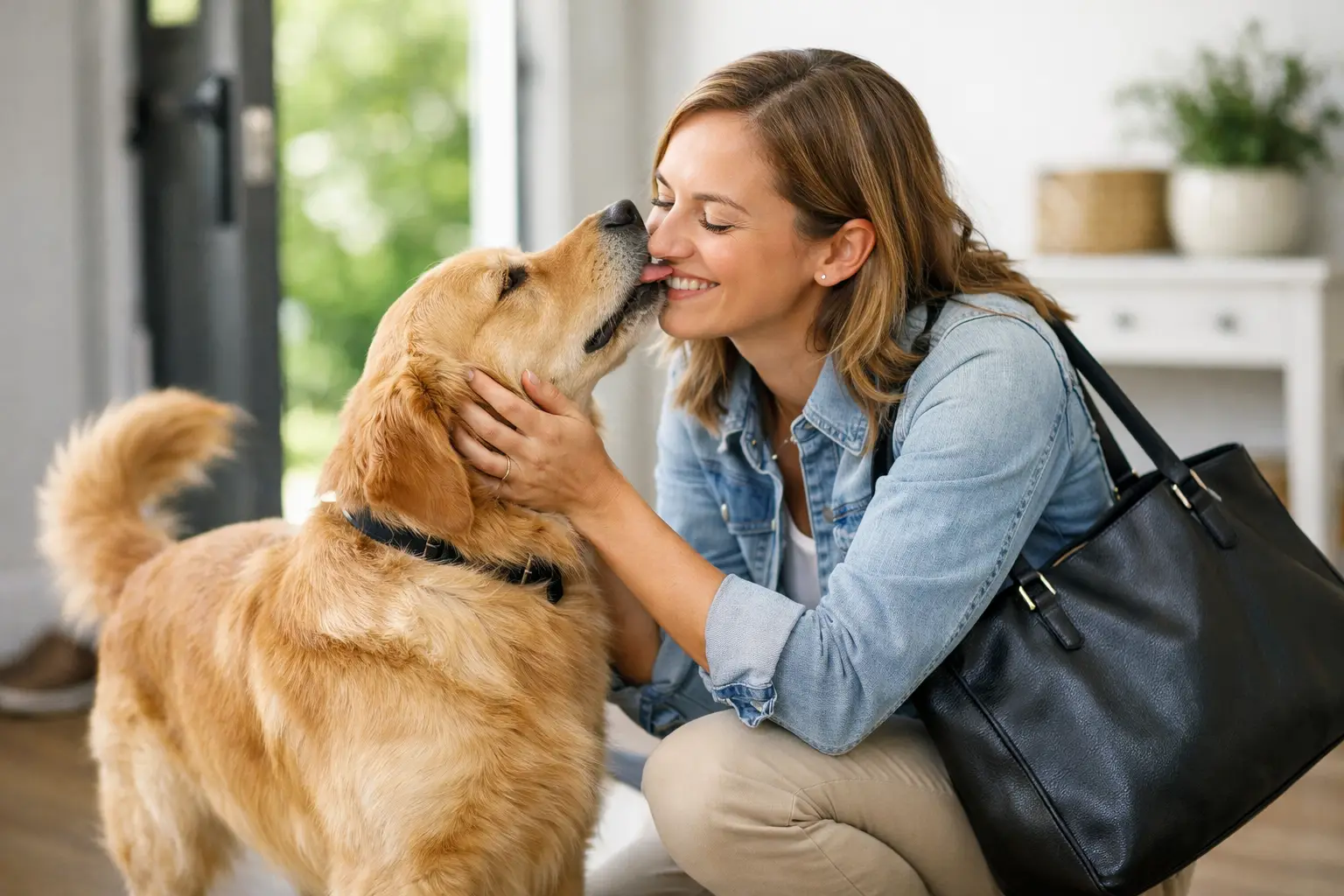
You open the door, your dog launches forward, and the first 20 seconds of coming home feel louder and more frantic than the rest of the evening. That is exactly why a dog greeting routine at home matters. The greeting itself is not a small moment. For many dogs, it sets the tone for arousal, barking, pacing, and hard-to-settle behavior long after you walk in.
Most owners make one understandable mistake here. They treat greetings like a manners problem only. In reality, greetings are usually an arousal regulation problem first and a manners problem second. If your dog is already spiking into excitement before contact happens, asking for calm behavior without a routine is like asking for quiet in the middle of a fire alarm.
Why your dog's home greeting gets out of control
Dogs do what gets repeated, and greetings are powerful. You arrive home, your body energy changes, your dog anticipates contact, and then the behavior loop starts. The dog rushes, jumps, vocalizes, spins, or mouths. You talk, touch, push away, laugh, or try to manage the chaos. Even when you do not mean to reward it, the whole scene becomes emotionally loaded.
For some dogs, the problem is social excitement. For others, it is frustration, insecurity, or a lack of clear recovery skills. This is why one dog may wiggle and jump while another barks and body slams the door. The behavior looks different, but the pattern is similar. The dog has learned that arrivals predict intensity.
That is also why random advice often falls apart. Telling owners to ignore the dog can help in some cases, but not in all of them. If the dog is escalating, rehearsing barking, scratching, or crashing into people, passive ignoring may simply let the chaos run longer. The better approach is a structured routine that gives the dog a job before the emotional spike takes over.
A better dog greeting routine at home
A useful dog greeting routine at home needs to be short, repeatable, and clear enough to use when you are tired, carrying bags, managing kids, or coming in from work. If it only works in perfect training conditions, it is not a household routine. It is a nice idea.
The goal is not to make your dog emotionless when you come home. The goal is to lower the intensity, shorten recovery time, and prevent the greeting from tipping into jumping, barking, door rushing, or post-arrival chaos.
A simple framework works best here: notice, reset, reward, release.
Notice means you pay attention to the first signs of arousal, not just the big explosion. Reset means you interrupt the pattern early with a predictable action. Reward means you reinforce the calmer state you want. Release means you let the dog move back into normal freedom once their body and brain are steadier.
That sequence matters because many owners skip straight to release. They open the door, greet warmly, and hope the dog settles after. Most excitable dogs do better when calm comes before full social access, not after.
Step 1: Set up the environment before you walk in
If your dog has a long history of explosive greetings, the routine starts before contact. That may mean using a gate, a leash station near the door, or a place bed a few feet away from the entry path. This is not a forever crutch. It is structure that prevents rehearsal.
Rehearsal is what keeps behavior sticky. Every time your dog gets to charge the door, jump on your body, or bark in your face, that pattern gets stronger. A clean setup gives you a chance to teach something different.
For some households, the best first change is simply creating space. If your dog is on top of you the second you enter, there is no room for regulation. Physical distance often lowers emotional intensity faster than repeated verbal cues.
Step 2: Enter quietly and keep your body language neutral
This part feels boring, and that is exactly why it works. Come in without squealing, rapid petting, or high-pitched greetings. Move slowly. Put your things down. Breathe. Let your arrival stop being a fireworks show.
Calm does not mean cold. It means steady. Many dogs mirror the energy we bring through the door, so if your first move is big social engagement, you can accidentally pour gasoline on the behavior you are trying to reduce.
If your dog starts escalating immediately, do not rush into affection to smooth it over. Pause. Stand still or move through your practiced reset step instead.
Step 3: Use one reset action every time
Your reset should be simple enough to repeat daily. For one dog, that may be guiding them to a mat and waiting for four paws on the floor. For another, it may be tossing a treat to a designated spot away from the doorway to break the forward rush. For a third, it may be clipping on a leash for 30 seconds of calm breathing and stillness before interaction.
The important part is consistency. If Monday means jumping gets petting, Tuesday means jumping gets scolding, and Wednesday means jumping gets ignored, your dog is still practicing excitement with no clear pattern. A routine works because the dog starts predicting what happens next.
If your dog is highly overstimulated, choose the easiest reset they can succeed with. This is not the moment to chase perfect obedience. It is the moment to create enough regulation for learning to happen.
Reward calm, not just commands
A common trap is rewarding the sit while missing the emotional state. A dog can sit while vibrating, whining, and ready to spring. That is not the same as a calmer greeting.
Look for softer signals. Four paws staying grounded. Less frantic movement. A quieter mouth. Slower tail action. A brief exhale. Eyes that are less locked on you. These moments matter because they tell you the dog's nervous system is actually coming down, not just pausing for payment.
Reward those moments with food, calm touch if your dog handles touch well, or access to you after the dog steadies. Access is a reward too. For many social dogs, being allowed to approach you in a controlled way is exactly what they want.
This is where timing matters. If you reward after the dog surges back up into jumping, you are paying for the old pattern. If you reward during the first real moment of settled behavior, you are teaching the dog what opens the door to greeting.
When to release your dog
Release should happen after the dog shows a lower-intensity body, not just because enough seconds have passed. Some dogs can regulate in 10 seconds. Others need a minute or two. It depends on age, temperament, history, and how strong the old habit is.
Release can mean permission to come say hello, move into the living room, or follow you without crowding. Keep that first release calm too. If your dog surges right back into jumping, the release came too early or with too much energy.
That is not failure. It is information. Tighten the routine, reduce your greeting intensity, and aim for a smaller success next time.
What to do if your dog still jumps or barks
If the behavior is deeply practiced, expect a transition period. Your dog may test the old pattern before the new one becomes reliable. That does not mean the routine is wrong. It usually means the dog is still checking whether the old version of coming home is available.
If jumping continues, increase management. Use a barrier, tether, or leash for the first minute so your dog cannot rehearse body contact. If barking continues, look at threshold. You may be waiting too long to reset. Start the routine at the sound of keys, the garage door, or footsteps outside instead of after the dog is already in a full reaction.
If your dog gets more wound up by food, use food differently rather than abandoning it entirely. Scatter to lower pressure. Deliver to a mat. Reward after stillness instead of luring through chaos. Tools are only helpful when they match the dog in front of you.
How long does a home greeting routine take to work?
You can often lower intensity within a few days if you are consistent, but real change comes from repetition. A dog greeting routine at home works best when it happens the same way across many arrivals, not just when you have extra patience.
That means everyone in the household needs the same plan. If one person practices calm arrivals and another encourages wrestling at the front door, your dog is getting mixed information. Consistency does not have to be perfect, but it does need to be recognizable.
Track two things: how intense the greeting is and how fast your dog recovers afterward. Those are better markers than asking whether the dog was perfect. A dog who still gets excited but settles in one minute instead of ten is making meaningful progress.
At Rubyjo K9, this is the kind of household training that changes daily life fastest. Not flashy tricks. Not one-off corrections. Just a repeatable system that tells your dog what happens when life gets activating.
The routine should fit real life
If your current plan is too complicated to use while holding groceries or managing a toddler, simplify it. The best home routine is the one you can repeat on your busiest day. One entry setup, one reset action, one reward pattern, one calm release. That is enough.
Your dog does not need a dramatic reunion to feel connected to you. Most dogs do better when the relationship feels predictable and safe. Calm arrivals create that safety. They tell your dog, over and over, that coming home does not need to tip the whole house into chaos.
Start with the next arrival, not a perfect future version of your dog. Small, steady reps at the door often create the calm you have been trying to get in the rest of the house.
Safety note
Safety note: if your dog shows aggression, intense fear, bite risk, pain, sudden behavior change, or medical concerns, contact a qualified professional or veterinarian before pushing the routine harder. This article is educational and is not a substitute for individualized behavior or veterinary care.