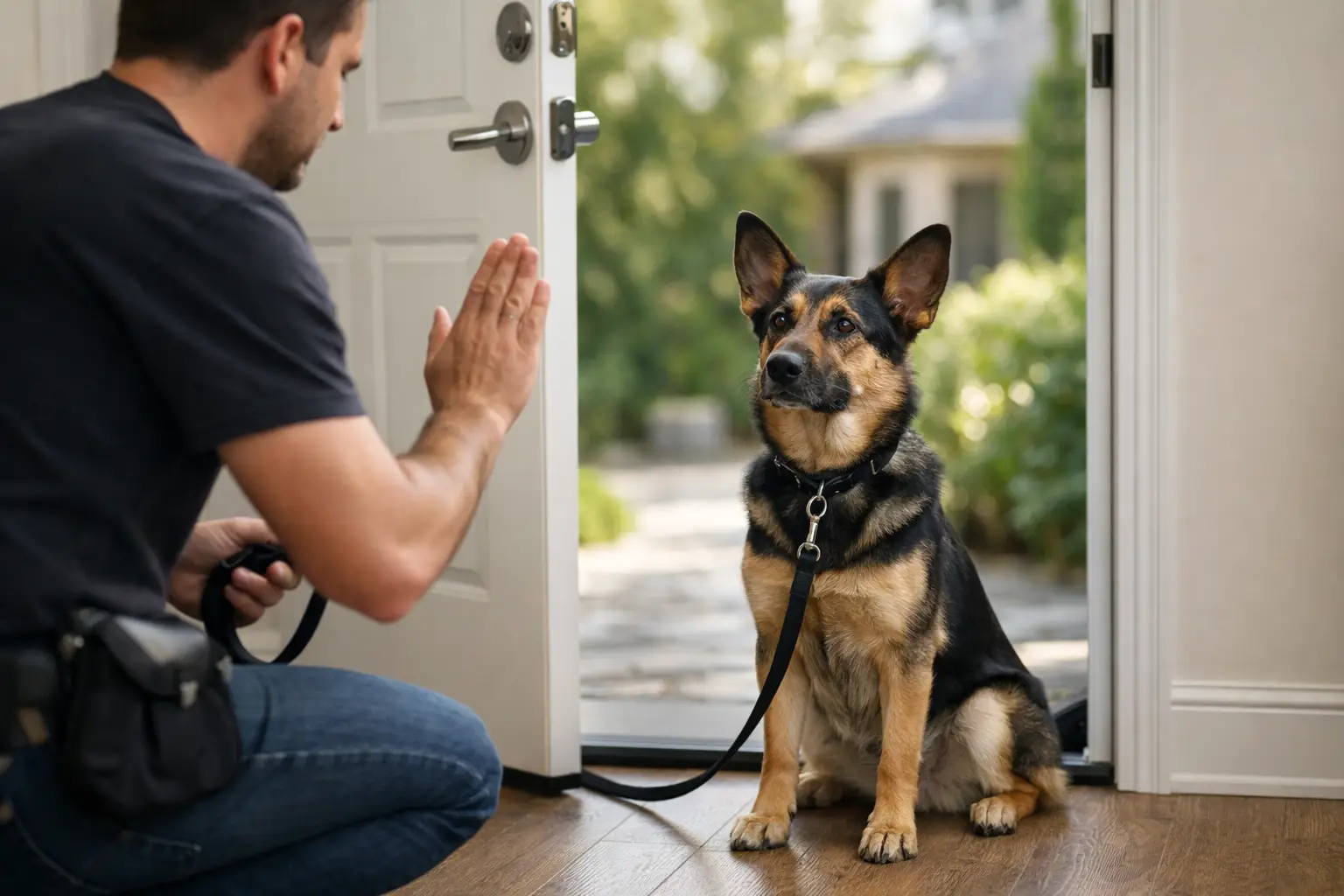
Your dog hears the leash clip, spots the front door, or sees a guest step inside - and suddenly their brain is gone. They are jumping, whining, pulling, or blasting through space like every routine has to start at full speed. Threshold training for dogs is one of the simplest ways to slow that pattern down and teach calm before movement.
This matters because many household behavior problems do not start with the big reaction. They start in the second before it. The doorway, the crate gate, the car door, the back gate, the front step, the porch, the threshold between the living room and the front hall - these are transition points. For an excitable or easily overstimulated dog, transitions are where self-control tends to fall apart.
Threshold work gives you a repeatable way to change that. Instead of correcting chaos after it starts, you teach your dog that access comes through pause, awareness, and release. That is a very different picture from dragging a dog back from the door or shouting over barking.
What threshold training for dogs really teaches
At its core, threshold training teaches your dog not to rush through openings just because they are available. The skill is not just "wait at the door." The deeper skill is emotional regulation during moments of anticipation.
That is why this training helps with much more than manners. A dog that can pause at a doorway is often easier to settle before walks, safer around guests, and less likely to practice frantic movement patterns that feed barking and pulling. You are not just creating a polite picture. You are building a behavioral habit: notice the opening, reset, wait for information, then move when released.
For busy households, that matters. You need training that fits into real life, not a 45-minute session with perfect conditions. Threshold reps happen naturally throughout the day. Every time your dog exits the crate, goes through the front door, enters the yard, or gets out of the car, you have a training opportunity.
Why dogs struggle at thresholds
Most dogs are not being stubborn at doors. They are responding to momentum, expectation, and arousal. The threshold predicts something exciting - outside access, motion, greeting, smells, freedom, a walk, people. Once that prediction gets strong, the body starts racing before the brain checks in.
Owners often make this worse without meaning to. They grab the leash only when it is time for a high-energy walk. They open the door while the dog is already pushing forward. They repeat cues while the dog is too activated to respond. Over time, the dog learns that frantic behavior and forward access happen together.
That is the real trade-off in threshold training. If you are inconsistent, the dog keeps rehearsing the old pattern. If you are clear and repetitive, the picture starts to change fast because the routine itself becomes predictable.
How to start threshold training for dogs at home
Start with the easiest threshold in your home, not the hardest one. For many dogs, the front door is too loaded at first. A crate door, baby gate, bedroom doorway, or quiet back door is often a better starting point.
Stand at the threshold with your dog on leash if needed. Open the space only a little. If your dog leans, surges, or pushes through, close the opening calmly. That closing is not punishment. It is information. Access is not available during forward pressure.
The moment your dog pauses, softens, shifts weight back, looks at you, or stands still, mark that change with calm praise or a simple marker and reward. Then release through the threshold. That sequence matters: pause first, access second.
A lot of owners rush the release. They get one second of stillness and fling the door open while the dog is already exploding forward. Try to hold the picture just long enough that your dog is actually thinking, not just freezing for a split second. Calm behavior has to be part of the pattern, not an accidental frame in a fast movie.
The routine that makes threshold work stick
Good threshold work is not complicated, but it does need structure. A simple loop works well: notice, reset, reward, release.
Notice means you watch the dog before the mistake fully happens. You are looking for rising pressure, leaning, paw lifting, vocalizing, scanning, or loading forward.
Reset means you calmly remove access if the dog rushes. You close the door, step back, or pause the movement. No lecture. No tugging match. Just a clean reset.
Reward means you reinforce the exact behavior you want instead - stillness, eye contact, a softened body, four paws grounded, or a step back from the opening.
Release means the dog moves through only after the calm pause. That final piece is what turns the threshold itself into reinforcement. The dog learns that self-control makes the good thing happen.
This is one reason the Rubyjo K9 approach works so well for household dogs. It turns behavior into a short repeatable routine instead of a guessing game. Owners do better when the next step is obvious.
Common mistakes that slow progress
The first mistake is starting with too much excitement. If your dog loses their mind at the front door before every walk, do not begin there and expect clean reps. Build the skill where your dog can succeed, then bring it to harder locations.
The second mistake is using the cue as background noise. Saying wait, wait, wait while your dog is actively pulling through the door teaches very little. The environment is louder than your voice in that moment. Your actions need to match the lesson.
The third mistake is drilling too long. Five clean reps are worth more than 20 messy ones. Threshold training should feel brief, clear, and repeatable. Stop before both of you get frustrated.
The fourth mistake is rewarding only with food and forgetting that access itself is powerful. For many dogs, going outside is the reward. Greeting the guest is the reward. Hopping out of the car is the reward. Use that naturally.
Where threshold training helps most
Front doors are the obvious place, but they are not the only place this matters. If your dog gets wild at the crate door in the morning, threshold work can slow the launch. If your dog body-slams the back door to chase squirrels, threshold work can interrupt that rehearsal. If your dog screams before jumping out of the car, threshold work can create safer exits.
It can also help with guest greetings, though this is where expectations need to stay realistic. A dog that is highly social or highly reactive may not go from chaos to perfect calm in a week. Threshold work can create a better starting point, but you may also need distance, leash management, place training, or shorter greeting routines.
That is the bigger truth with household behavior. Threshold work is powerful, but it is not magic. It is one piece of emotional regulation. The dog still needs enough sleep, enough decompression, and enough consistency across the rest of the day.
How to know it is working
Do not measure progress by asking whether your dog is perfect. Measure whether the pause is showing up faster, whether resets are decreasing, and whether the body looks softer before release.
A dog who used to blast through every opening might start hesitating for one second. Then two. Then they may glance at you instead of auto-launching. That is progress. A dog who used to scream at the back door might stand quietly while you reach for the handle. That counts too.
Keep the standard realistic for the dog in front of you. Young dogs, high-drive dogs, and dogs with a long history of frantic rehearsal usually need more repetition. Sensitive dogs may understand the pattern quickly but become worried if the owner gets tense or overly corrective. The process should feel calm and clear, not heavy.
Making threshold training part of daily life
The easiest way to fail with training is to treat it like a separate event you never have time for. The easiest way to succeed is to attach it to routines that already happen.
Use one threshold consistently for a week. Aim for a handful of clean reps each day. Keep your criteria simple. Pause, reward, release. Once that looks solid, bring the same routine to a harder doorway or a more exciting context.
You do not need a huge plan to start. You need one doorway, one calm standard, and the patience to repeat it without rushing. Dogs learn from what happens every day, not from the best intentions you had on Saturday.
If your home feels chaotic right now, threshold work is a good place to begin because it changes the moments that usually tip everything over. A calmer exit often leads to a calmer walk. A calmer doorway often leads to a calmer greeting. Sometimes the fastest way to reduce household stress is not doing more. It is slowing down one transition until your dog can handle it well.
FAQ
How long does threshold training take to work?
Most dogs show improvement within the first week if you practice consistently at one low-distraction threshold. The first clean pauses may only be one to two seconds, and that is normal. Real progress depends less on calendar days and more on repetition quality. Five clean reps a day at a quiet doorway will produce faster results than occasional sessions at the busy front door. If you see no change after two weeks of consistent practice, check whether your criteria are clear enough and whether the threshold is too exciting for the dog's current skill level.
Can I teach threshold training without a leash?
Yes, but the leash helps set the picture early on. If your dog rockets through every opening, a short leash gives you a way to prevent rehearsal while the dog learns the new rule. Once the dog understands that paused access is the pattern, you can fade the leash at that threshold. Keep it available for harder thresholds or when arousal is higher than usual, such as visitor arrival or an especially exciting walk.
Should I use treats or the door itself as the reward?
Both can work, and the best approach depends on what your dog values most. If your dog is highly motivated to go outside or greet people, the opening itself is a powerful reward. You can mark the pause and release through the door without food. If your dog is less driven by outdoor access, pair the pause with a small treat and then release through the threshold anyway so the pattern stays clear. Over time, many dogs respond to the access reward alone, which makes the routine easier to maintain in daily life.
Does threshold training fix door dashing for good?
It is one of the most reliable tools for door dashing, but it usually needs to be paired with management. A dog that has a long history of exploding through doors may still try the old pattern when extra excited or when the owner is distracted. Use a baby gate, a tether station, or a crate near the door as a backup while the dog builds the habit. Over weeks of clean practice, the threshold rule becomes more automatic, and the backup management can relax.
What if my dog refuses to pause at the door at all?
If your dog cannot hold still for even half a second at the front door, you have two options: change the threshold or change the arousal level. Try a quieter doorway first, such as a bedroom door or crate gate, where nothing dramatic happens after the release. You can also practice when your dog is already calm, such as after a walk or a decompression nap, rather than before a high-energy activity. The skill grows from easy wins, not from forcing the hardest version first.
Safety note
If your dog shows aggression, intense fear, bite risk (including redirected biting), pain, sudden behavior change, or medical concerns, stop and contact a qualified professional, certified force-free trainer, or veterinarian before pushing the routine harder. This article is educational and is not a substitute for individualized behavior or veterinary care.