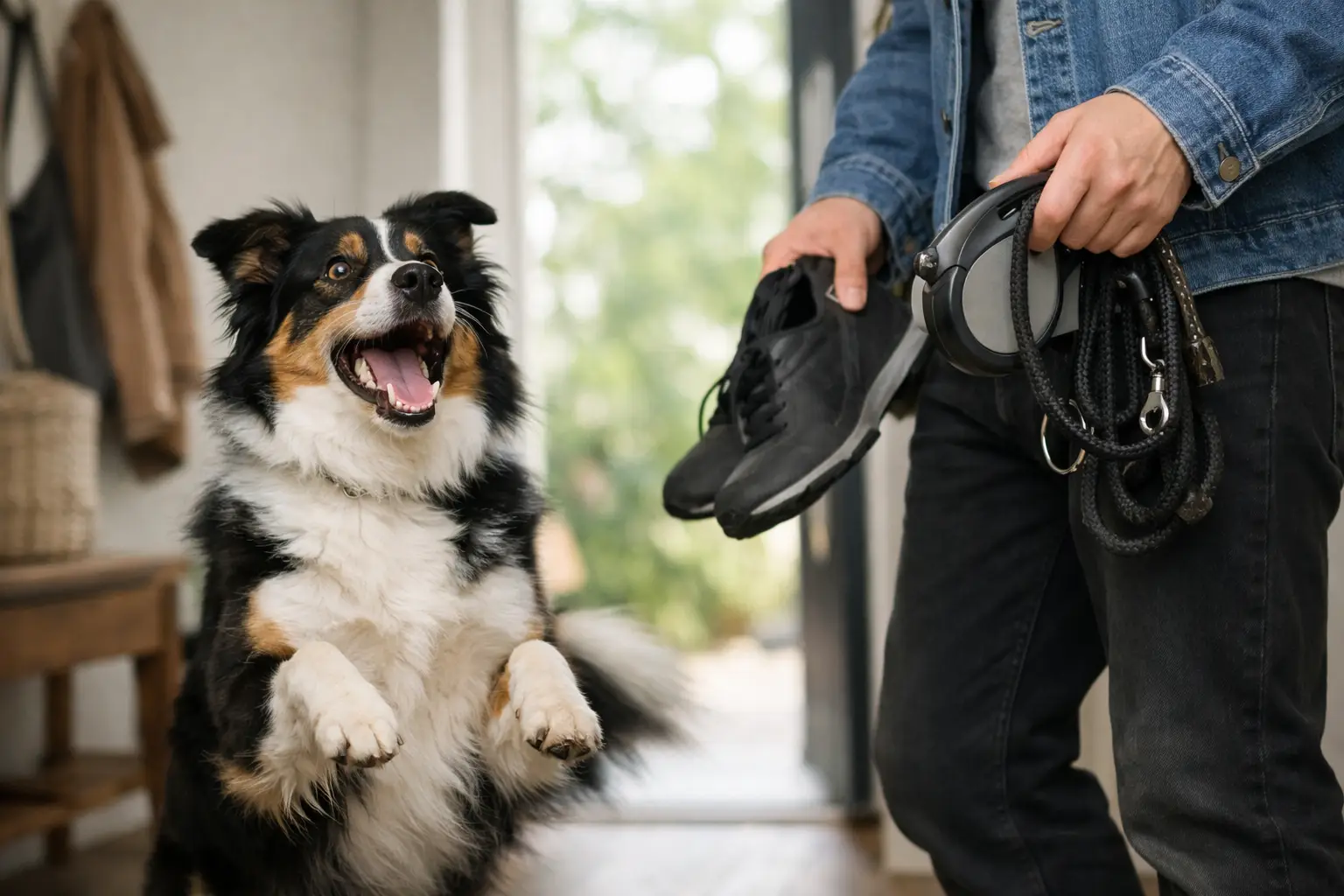
The leash comes off the hook, and your dog is already spinning, whining, jumping, or racing from room to room. If your dog is overexcited before walks, the walk itself is only part of the picture. What you are really seeing is a predictable arousal pattern that starts with anticipation, builds through your prep routine, and spills over before you ever reach the door.
That matters because a dog who starts the walk at a 9 out of 10 is far more likely to pull, bark, ignore cues, and react to normal things outside. The goal is not to make your dog less happy about walks. The goal is to help your dog handle that excitement without losing control.
Why a dog gets overexcited before walks
Most owners assume the leash is the trigger. Sometimes it is, but often the leash is just one part of a larger sequence your dog has memorized. Shoes go on, keys move, you head toward the hook, and your dog starts escalating because the pattern predicts a highly rewarding event.
This is not stubbornness or your dog trying to be dominant. It is learned anticipation mixed with a rising stress-and-excitement response. For many dogs, that state feels automatic. They are not making thoughtful choices in that moment. Their body is simply running the old routine faster than their brain can stay regulated.
Some dogs also have a long reinforcement history for pre-walk chaos. If jumping, spinning, barking, and crashing into the door still lead to the walk happening, the behavior is being rehearsed and confirmed every day. Not because you meant to teach it, but because the sequence keeps paying off.
Dog overexcited before walks: what not to do
Trying to outtalk the chaos usually makes it worse. Repeating "wait," "calm down," or "no" while clipping the leash onto a bouncing dog often adds more noise to an already overloaded moment. The dog is not refusing to listen out of spite. They are over threshold.
Rushing can also trap you in the same cycle. When you are late, tired, or trying to get the walk started before work, it is easy to think, "We just need to get outside." But every rushed exit teaches the dog that frantic energy still gets released through the door.
At the same time, expecting a perfect sit for two full minutes may not be realistic either. This is where many owners get stuck. They swing between letting the dog explode and demanding more control than the dog can currently offer. Good training lives in the middle. You want calm enough to proceed, not robotic stillness.
Start with a lower bar and a clearer routine
The fix is structure, not intensity. A dog who is overexcited before walks needs a repeatable pattern that lowers arousal in small steps. That means you stop treating the walk as one big event and start breaking it into moments your dog can actually succeed in.
At Rubyjo K9, we teach household behavior through a simple loop: Notice, Reset, Reward, Release. It works well here because pre-walk excitement is easiest to change when you stop reacting emotionally and start working through the same calm sequence every time.
Notice the first sign, not the biggest one
Most owners intervene too late. They wait until the dog is barking, launching, or scratching at the door. By then, the dog is already fully activated.
Instead, notice the earliest signs that your dog is tipping up. Maybe it is staring at the leash, pacing when you put shoes on, vibrating in place, or rushing ahead to the door. That is the moment to work. Early interruption is easier than late recovery.
Reset before continuing
A reset is not punishment. It is a brief pause that breaks the automatic chain. If your dog surges forward when you reach for the leash, stop the sequence. Step back. Put the leash down if needed. Wait for a small drop in arousal: four paws on the floor, a softening in the body, one second of stillness, a look back at you.
That reset may be short at first. For some dogs, one calm breath is where you begin. That is fine. You are not testing endurance. You are teaching that calmer behavior keeps the routine moving.
Reward what you want to repeat
The reward can be food, but it can also be the process continuing. This is where timing matters. If your dog offers a calmer moment, mark it clearly with a quiet "yes" or another marker you use, then reward.
For many dogs, using a small food reward during harnessing or leash clipping helps slow the body down enough to learn. For others, the strongest reward is simply that the next step happens. It depends on the dog. Food is useful, but access to the walk is part of the picture too.
Release only when the picture is calm enough
Release does not mean your dog must become perfectly zen. It means the dog is regulated enough to move to the next step without exploding. If the leash appears and your dog can stand, sit, or pause with a softer body, that is enough to continue.
If excitement spikes again at the door, reset again. Calm behavior opens the next part of the routine. High arousal pauses it.
A practical pre-walk routine that works in real life
You do not need a 30-minute ritual before every walk. You need a short sequence you can repeat consistently.
Start by separating your own prep from your dog's prep. Put your shoes on, grab what you need, and get yourself ready before you cue the dog that a walk is happening. If your dog explodes the second they hear keys or see your jacket, do those things at random times during the day too. That helps weaken the prediction over time.
Next, bring the leash or harness into the picture only if your dog is under the current threshold. If the sight of the harness causes immediate jumping, hold it for a second, then put it away when your dog escalates. Bring it back when your dog settles. The message stays consistent: calm keeps the routine moving.
Then clip gear on in stages if needed. For some dogs, the full sequence is too much. You may need to touch the harness, reward calm, pause, then continue. Slower now creates smoother later.
At the door, do not race to open it just because your dog technically sat once. Look at the whole dog. Is the body loose enough to think? Can your dog pause instead of launching? If not, reset and try again. This is where progress compounds.
Dog overexcited before walks outside the front door too
A common mistake is assuming the problem ends once the door opens. But if your dog blasts through the exit, drags you down the path, and hits the sidewalk in a frenzy, the same arousal pattern is still running.
The first 30 to 60 seconds matter. If needed, take one step out and stop. Wait for slack in the leash, a check-in, or a softer body, then continue. You are teaching your dog that the walk begins in regulation, not in a sprint.
This part can feel slow for the first week or two. That does not mean it is failing. It usually means your dog is finally practicing a different start.
How long does it take to change pre-walk excitement?
That depends on the dog, the rehearsal history, and how consistent the household is. A young, high-energy dog with months of frantic exits will not look different overnight. A dog with milder anticipation may improve quickly once the routine changes.
What matters most is repetition. If you practice calm starts on weekdays but rush chaotic ones on weekends, progress gets muddy. You do not have to be flawless, but your dog does need a clear pattern more often than not.
Track simple wins. Did the whining start later today? Did leash clipping happen without jumping? Did your dog recover faster at the door? These are real markers of progress, even before the whole routine looks polished.
When excitement is actually too high for training
Sometimes a dog who is overexcited before walks is not just enthusiastic. The dog may be chronically under-rested, under-enriched in the right ways, frustrated by constant trigger exposure, or living with a nervous system that rarely comes down.
If your dog is also struggling with barking at windows, exploding at sounds, pacing at night, or reacting hard on walks, pre-walk chaos may be one symptom of a broader regulation problem. In that case, the fix is not just "practice door manners." You need a calmer daily structure overall: better decompression, clearer routines, and less accidental rehearsal of high arousal all day long.
That is why short, repeatable household reps usually work better than occasional big training efforts. You are not trying to win one moment at the door. You are building a dog who can recover faster and stay steadier across the day.
If your dog is overexcited before walks, the good news is this pattern is trainable. Not with louder commands or stricter pressure, but with cleaner timing, lower thresholds, and a routine your dog can predict. Start earlier than you think. Reward smaller moments than you think. Repeat it more calmly than feels necessary. That is often where the change begins.
FAQ
Should I use food rewards at the door or will that make my dog more excited?
Food rewards at the door can actually lower arousal when used correctly. The key is calm delivery: place a treat on the floor or offer it without fanfare. The act of sniffing and eating engages the parasympathetic nervous system, which helps the body slow down. Avoid tossing treats or using an excited voice, which can push arousal higher. For some dogs, a calm food scatter on the floor while you clip the leash is one of the fastest ways to bring the energy down.
My dog is calm inside but explodes the second we step outside. What do I do?
This is very common and usually means the threshold shifted at the door itself. The fix is not to practice more inside: it is to practice at the door, then just outside it, in tiny steps. Open the door, wait for any drop in tension (even a small one), then close it. Repeat until your dog starts anticipating the pause instead of the sprint. When you do step out, stop after one step and wait for the leash to slacken. The first minute outside sets the tone for the entire walk.
Can I still use a harness if my dog gets overexcited during putting it on?
Yes, but slow the process down. If your dog jumps or mouths when the harness appears, work in stages: show the harness, reward calm, put it away. Show the harness, touch it to the dog's side without clipping, reward calm, put it away. Only progress to full clipping when your dog can stay soft for the previous step. A harness that clips at the back is often easier to put on a wiggly dog than an over-the-head style. If the current harness is a daily fight, switching to a different style can remove a major trigger.
What if I don't have time for a calm pre-walk routine every single walk?
Consistency matters more than perfection. If three walks a day are not realistic, make one walk the "training walk" where you follow the full calm routine, and keep the other walks as short and uneventful as possible. Even one calm start a day will build the pattern over time. On rushed days, separate your prep from your dog's prep and try to clip the leash only when your dog has four paws on the floor: even that small boundary keeps the message alive that calm moves things forward.
Safety note
If your dog shows aggression, intense fear, bite risk, pain, sudden behavior change, or medical concerns around walks or handling, contact a qualified professional or veterinarian before pushing the routine harder. This article is educational and is not a substitute for individualized behavior or veterinary care.