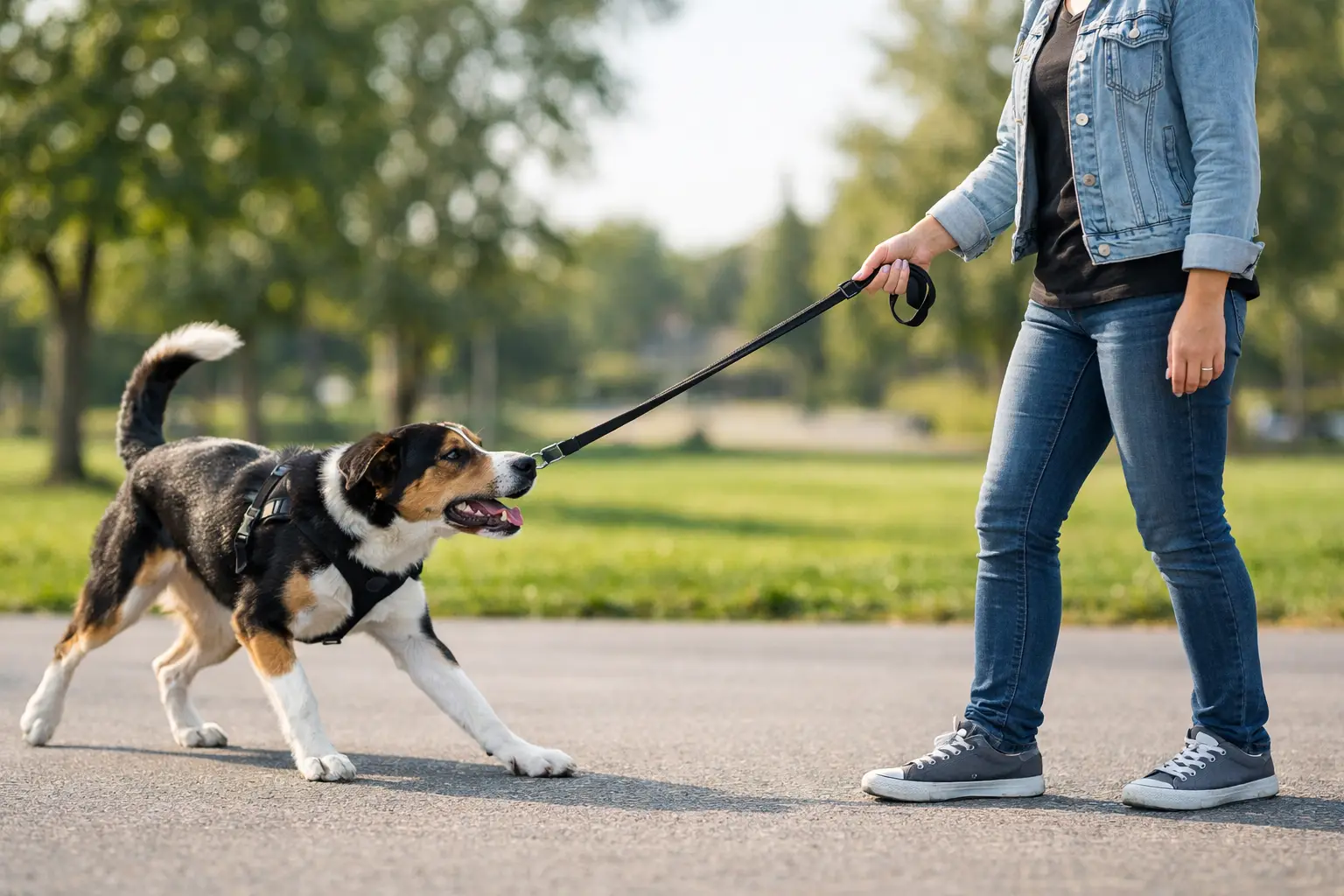
The walk usually starts going wrong before you ever touch the leash. Your dog sees you reach for it, starts spinning, whining, bouncing at the door, and by the time you step outside, their brain is already moving faster than their body can handle. If you want to know how to stop leash pulling, that is the first shift to make: stop treating pulling as a walk problem only.
For most dogs, pulling is part excitement, part habit, and part lack of clarity. They have learned that leaning forward gets them where they want to go. Smells get closer. The sidewalk opens up. The walk continues. Even if you occasionally stop or say no, the overall pattern still pays off often enough to keep the behavior alive.
That is why random corrections rarely create lasting change. A dog who is overstimulated, rushed, or rehearsing the same pattern every day does not need more noise. They need a calmer entry into the walk, a clear rule they can understand, and enough repetition for the new pattern to feel familiar.
How to stop leash pulling starts before the walk
If your dog explodes with energy the second the leash appears, you are not dealing with a loose-leash skills issue alone. You are dealing with arousal. A dog who is already over threshold in the hallway is much less capable of making good choices on the sidewalk.
Start by slowing down the pre-walk routine. Pick up the leash, then pause. If your dog surges, spins, barks, or crowds you, do not rush to clip in and head out. Wait for a small reset: four paws on the ground, a softer body, a moment of stillness. Then continue.
This is where the Rubyjo K9 method helps: Notice the excitement, Reset by pausing or stepping back, Reward the calmer choice, and Release your dog to the next step. That sequence teaches your dog that calm behavior moves the routine forward, not frantic behavior.
It will feel slower at first. That is normal. You are not wasting time. You are preventing the first ten minutes of the walk from becoming a wrestling match.
Why dogs keep pulling on leash
Pulling continues because it works, and because many dogs have never been shown a clean alternative in real-life conditions. Indoors, they may walk nicely for treats. Outside, the environment becomes the bigger reward.
There is also a pacing issue that owners often miss. People tend to start moving fast, keep the leash tight, and talk constantly once the dog begins pulling. From the dog's perspective, that can create even more tension and urgency. The leash stays taut, the body leans forward, and the dog rehearses exactly what you are trying to stop.
A better goal is not "make my dog walk perfectly beside me forever." A better goal is this: teach the dog that leash pressure does not lead them forward, and staying connected to you does.
That is a simpler lesson. It is also more realistic for everyday life.
The most effective way to train loose-leash walking
You do not need a complicated routine, but you do need consistency. Pick one walking rule and stick to it. For most households, the clearest rule is that the leash stays loose if the walk keeps moving.
Start in the easiest place possible. That might be your driveway, the hallway of your apartment building, or ten feet in front of your house. If your dog cannot stay with you there, the neighborhood loop is too hard right now.
The moment the leash tightens, stop. Not with frustration. Not with a verbal lecture. Just stop. Wait for your dog to release tension by shifting back, turning toward you, or softening the leash. The second that happens, mark it with calm praise or a food reward, then move forward again.
This teaches a clean cause and effect. Tight leash makes the environment stop. Loose leash makes the walk continue.
For some dogs, especially very excitable ones, you may get better results by changing direction after tension instead of standing still too long. If stopping sends your dog into louder frustration, a quiet turn and a few steps the other way can interrupt the pattern without creating a standoff. It depends on the dog. The important part is that pulling does not successfully drag you to the next thing.
Reward more than you think you should
Many owners wait too long to reward. They notice pulling, pulling, pulling, then finally the dog gives one decent step and the moment passes. Early in training, you want to catch the small wins.
Reward when your dog checks in. Reward when they match your pace for a few steps. Reward when they choose to come back into position after noticing a distraction. These are the repetitions that build the walk you actually want.
Food is often the fastest way to create new walking habits, especially outside where distractions are strong. That does not mean you will need treats forever. It means you are paying clearly for a behavior that competes with a very stimulating environment.
If your dog is too amped up to take food outdoors, that is useful information. Training is currently happening in a space that is too hard, too soon. Move back to an easier location and rebuild there.
How to stop leash pulling without turning every walk into a training session
This is where owners get stuck. They hear that every pull must be addressed, but they also need to get around the block, get to work, or help the kids get out the door. Real life matters.
Use a split approach. Have training walks and exercise walks, but be honest about the difference. On a training walk, your focus is loose-leash practice in short windows with full consistency. On an exercise walk, your focus may be movement, decompression, and getting energy out in a lower-conflict way.
If your dog is still learning, expecting a perfect neighborhood walk during your busiest part of the day may be unrealistic. That does not mean training failed. It means the context matters.
You can also shorten the training window. Five solid minutes of focused leash work near home is often more productive than thirty messy minutes of repeating the same struggle. Small, clean reps create faster progress than long, frustrated ones.
Equipment helps, but it does not replace training
A standard leash and a well-fitted harness are enough for many dogs. For others, a front-clip harness can reduce leverage while you build better habits. That can make walks safer and more manageable, especially if you are dealing with a strong dog.
What equipment cannot do is teach emotional regulation by itself. If the dog is leaving the house at a level ten every day, changing gear may improve control, but it will not solve the pattern. The routine still matters.
Skip the mindset of finding one magic tool. Look for equipment that helps you stay calm, consistent, and physically safe while training the actual skill.
Common mistakes that slow progress
The biggest mistake is inconsistency. If pulling works on Monday, gets corrected on Tuesday, works again on Wednesday, and is ignored when you are in a rush, your dog is getting mixed information.
The second mistake is asking for too much too soon. Owners often go from zero structure to expecting a calm half-hour walk past dogs, squirrels, delivery trucks, and kids on scooters. That is a lot. Build in layers.
The third is focusing only on the leash and ignoring recovery. Dogs need moments of decompression, sniffing, and lower pressure too. A walk that is all control and no release can create more frustration, not less. Calm structure works best when the dog also gets appropriate opportunities to be a dog.
What progress should actually look like
Progress is not always dramatic. First, your dog may recover faster after hitting the end of the leash. Then they may check in more often. Then the first two minutes of the walk feel less chaotic. Then one block becomes manageable before they lose focus.
That counts.
If you are waiting for one perfect walk to prove the training is working, you may miss the real signs of change. Look for shorter pulling episodes, softer body language, faster resets, and more moments where your dog can respond before getting carried away.
At Rubyjo K9, we teach owners to look for repeatable wins, not random good days. That shift matters because calm walking is usually built through pattern change, not through one breakthrough moment.
If your dog pulls because they are excited, overstimulated, or simply used to leading the walk, the answer is not to overpower them. It is to make the routine clearer, slower, and easier to repeat. A calmer walk starts with a calmer first minute, and that is something you can practice tomorrow.
Frequently asked questions about leash pulling
Should I use a harness or a collar for leash training?
A well-fitted harness: especially a front-clip style: is generally safer for dogs who pull. It reduces pressure on the neck and gives you better control while training. Collars work for dogs who already walk calmly, but switching to a harness during the learning phase prevents injury and helps you train more comfortably.
How long does it take to stop leash pulling?
Most dogs show measurable improvement within two to four weeks of consistent, short daily practice. The key variable is how often your dog rehearses the pulling pattern outside of training sessions. If every walk becomes a training opportunity: even just for the first five minutes: progress tends to be faster and more durable.
My dog pulls more when they see other dogs. What should I do?
Create more distance first. Cross the street, step behind a car, or turn around before your dog locks onto the other dog. Practice engagement exercises (check-ins, hand targets, treat scatters) at a distance where your dog can still respond. Close the gap gradually over days and weeks, not all at once.
Will my dog ever walk nicely without treats?
Yes, but treats are a tool, not a crutch. Think of them as a clear payment system while your dog learns what you want. As the behavior becomes more automatic, you can shift to real-life rewards (sniffing, moving forward, verbal praise) and phase out food gradually. Most dogs still benefit from occasional treat reinforcement on high-distraction walks.
What if I have a very strong dog and I cannot hold them back?
Safety comes first. Use a front-clip harness or a head halter as a management tool while you build the training foundation. Practice in the easiest environment possible: even inside your home or driveway: before tackling real walks. If safety is a concern, consider working with a qualified force-free trainer who can demonstrate techniques hands-on.
Safety note
If your dog shows aggression, intense fear, bite risk, pain, sudden behavior change, or medical concerns, contact a qualified professional or veterinarian before pushing the routine harder. This article is educational and is not a substitute for individualized behavior or veterinary care.
Every dog is different. Results depend on consistency, the dog's history, and the environment. If something is not working after several weeks of consistent practice, consult a qualified force-free trainer who can observe your specific situation.