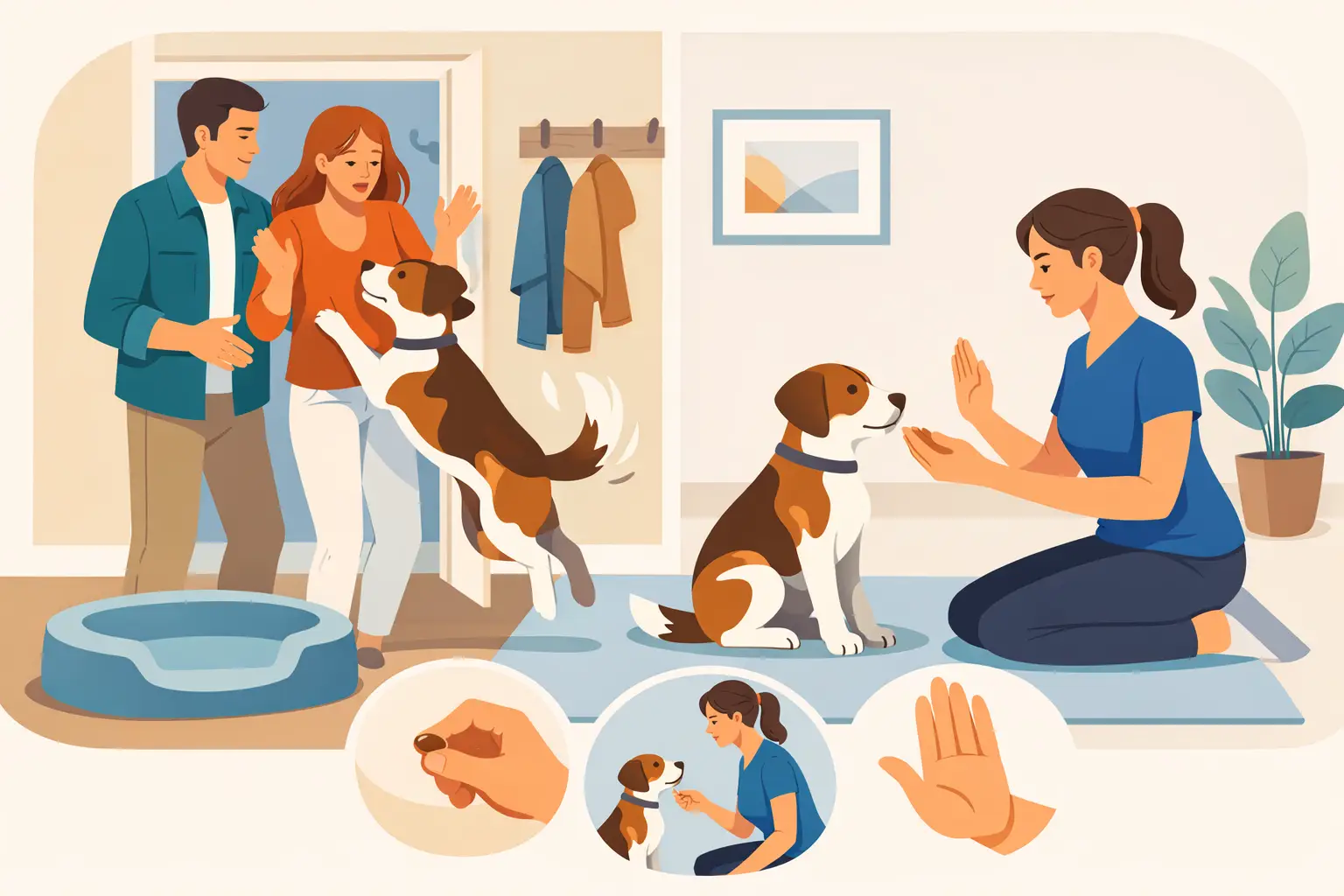
The knock happens, your dog launches forward, and before you can say "off," your guest is bracing for impact. That is why dog jumping on guests training needs to start before the front door opens, not in the middle of the chaos. If greetings always begin at full speed, your dog is rehearsing the exact behavior you want to change.
Jumping is not usually defiance. It is often a mix of excitement, social seeking, stress, and poor impulse control in a high-trigger moment. For a lot of dogs, guests create a perfect storm - movement, voices, eye contact, door sounds, and the owner's own tension. If you only focus on stopping the paws in the air, you miss the bigger pattern driving the behavior.
Why dogs jump on guests in the first place
Most owners already know their dog is excited. The more useful question is what kind of excitement you are seeing. Some dogs are socially pushy and have learned that jumping gets attention fast. Some are overstimulated and lose access to any calm choice the second the doorbell rings. Others are conflicted - eager to approach but too wound up to do it appropriately.
That distinction matters because training goes better when you stop treating every jumping dog the same way. A confident adolescent dog may need much more structure around greetings. A nervous but frantic dog may need more distance, slower exposure, and less social pressure from guests. The visible behavior looks similar, but the path forward can be slightly different.
One part stays the same. Jumping continues when the dog repeatedly practices it and gets some kind of payoff. Attention, touch, eye contact, excited voices, or simply getting closer to the person can all reinforce the behavior. Even pushing the dog away can keep the interaction going.
Dog jumping on guests training starts before the greeting
If your plan begins when your dog is already airborne, you are late. The cleanest progress comes from changing the routine that leads into the greeting. Think of the moment in four parts: your dog notices the trigger, you interrupt the spiral, you reinforce the calmer choice, and only then do you allow access again.
That is much more effective than repeating "down" while your dog gets increasingly frantic. Household behavior changes when the sequence changes.
Start by removing the expectation that every knock or visitor means immediate contact. Many dogs jump because the door opening has become a release cue. They hear the bell, race forward, and expect to meet the person at peak arousal. Your job is to break that chain.
A simple setup helps. Before opening the door, have your dog on leash or behind a gate if needed. Keep your movements quiet and predictable. Ask for a station behavior your dog already understands, like standing with four paws on the floor near you, going to a mat, or pausing behind a barrier. If your dog does not yet have that skill, begin with distance and management rather than expecting a polished greeting right away.
The routine that works in real life
Most busy households do better with one repeatable pattern than with five different techniques. Use this sequence every time possible: Notice, Reset, Reward, Release.
When your dog notices the guest, watch for the first signs of escalation. That might be rushing forward, whining, spinning, or leaning hard into the leash. Reset before the explosion. Your reset could be guiding your dog back to a mat, creating more distance, turning away from the door, or pausing behind a gate until the body softens.
Then reward the version of your dog you want to see more often. That means reinforcing four paws on the floor, a brief check-in, a calmer stand, or a settled pause. The reward should come while the dog is making the better choice, not several seconds later after the moment has passed.
Release is the part owners often skip or rush. Release does not mean "go lose your mind." It means your dog earns a little more access only after showing enough regulation to handle it. Sometimes that release is two steps closer to the guest. Sometimes it is a brief sniff and then back to you. Sometimes, especially early on, there is no direct greeting at all. That is still training.
What to do when your dog is too worked up to greet
This is where honesty helps. If your dog cannot stay on the floor for two seconds, cannot take food, or is vibrating with full-body excitement, your dog is over threshold. In that state, polite greeting practice usually falls apart.
When that happens, stop trying to force a normal social interaction. Use management first. Put your dog behind a gate, in another room with a chew, or on leash at a greater distance while your guest settles in. Let the energy come down before attempting any closer work.
Some owners worry this is avoiding the problem. It is not. It is preventing bad repetitions while your dog builds skill. You cannot train calm in the same way you train a trick if the nervous system is already overloaded.
How to practice without waiting for real guests
Real visitors are unpredictable. They come in talking, moving, laughing, carrying bags, and doing all the things that make training harder. So your best progress often comes from controlled practice sessions, not surprise greetings.
Rehearse the small pieces. Practice leash pickup without excitement. Practice walking to a mat when someone knocks lightly. Practice opening and closing the door while your dog stays under threshold. Practice a friend stepping in, pausing, and ignoring the dog while you reward calm behavior.
Keep these sessions short. Five good repetitions are more useful than one chaotic greeting that unravels everything. End while your dog is still capable of success.
If you need an easier starting point, remove one layer of difficulty. Ask your helper not to speak. Have them enter sideways instead of facing the dog. Keep them seated instead of walking toward your dog. Training is not weaker because it starts small. It is usually stronger.
The guest's role matters more than most people think
Your dog is not training in a vacuum. Guests often accidentally reward jumping by reaching out, laughing, talking in a high voice, or making direct eye contact. That does not make them bad guests. It just means they need simple instructions.
Before they come in, tell them exactly what to do. Ask them to ignore your dog at first. No touching, no talking, no bending over, no pushing away. If your dog approaches calmly with four paws on the floor, then they can offer brief attention if you say it is okay.
This can feel awkward the first few times, especially with family who think the jumping is cute. Stay firm anyway. Mixed responses slow progress. Dogs learn from patterns, not from our intentions.
Common mistakes in dog jumping on guests training
The biggest mistake is giving the dog access too soon. Owners often see one second of calm and rush the greeting, only to get another jump. Calm needs to be stable enough to hold under pressure.
The second mistake is using cues the dog cannot follow in that moment. If "sit" works in the kitchen but disappears at the door, that is not stubbornness. It is a sign the environment is too hard. Lower the intensity and rebuild.
The third mistake is inconsistency between household members. If one person rewards calm greetings and another allows launching, progress gets muddy. The dog will keep trying the behavior that has worked before.
Finally, do not confuse stillness with true regulation. A dog can freeze in place for a second and still be ready to explode forward. Watch the whole body. Soft muscles, easier breathing, and the ability to disengage briefly from the guest tell you much more than a fast sit ever will.
What progress really looks like
Progress is usually not dramatic. First, the jump intensity drops. Then recovery gets faster. Then your dog can pause, reset, and approach with more control. Later, greetings start to look ordinary, which is exactly what most owners want.
Some dogs improve quickly once the routine changes. Others need several weeks of repetition, especially if they have a long history of practicing frantic greetings. Age, temperament, household traffic, and your own consistency all affect the timeline.
This is where a simple system helps. Rubyjo K9 teaches household behavior through short, repeatable routines because calm greetings are not built through random corrections. They are built through consistent reps your dog can actually succeed with.
You do not need a perfect dog at the door. You need a dog who can notice a guest, recover, and make a better choice before the moment snowballs. That is a realistic goal for busy households, and it is enough to change the entire feel of your home.
The next time someone knocks, think less about stopping the jump and more about slowing the sequence that creates it. Calm is easier to build when you stop waiting for chaos to begin.
FAQ
Why does my dog only jump on certain people?
Dogs often jump more on people who give an exciting reaction — high voices, direct eye contact, reaching hands, or quick movements. Some guests also carry higher novelty value (rare visitors, children, delivery people). The pattern is the same regardless of who triggers it: your dog rehearses jumping because it has been reinforced in the past, even accidentally, by that person or by similar situations.
How long does it take to stop a dog from jumping on guests?
Most dogs show noticeable improvement within one to two weeks of consistent practice with the same routine. Durable, reliable change — where your dog defaults to four paws on the floor without constant cueing — usually takes three to six weeks. Dogs with a long history of jumping may need more repetition because they are unlearning a deeply practiced habit.
Should I use a leash indoors for guest greetings?
Yes — a leash is one of the most practical management tools for jumping training. It allows you to guide your dog away from the guest, maintain distance, and prevent the jumping from being rehearsed, all without raising your voice or physically pushing the dog. Use a standard flat leash, not a retractable one, and keep it loose when your dog is calm so it does not become a source of tension.
Safety note and professional support
Safety note: if your dog shows aggression, intense fear, bite risk, pain, sudden behavior change, or medical concerns, contact a qualified professional or veterinarian before pushing the routine harder. Jumping that escalates to mouthing, nipping, or body-slamming during greetings may signal a deeper arousal or anxiety issue that needs in-person assessment. This article is educational and is not a substitute for individualized behavior or veterinary care. For dogs with a history of knocking people over or redirecting frustration onto handlers during greetings, work with a certified force-free trainer who can assess your specific situation in person.