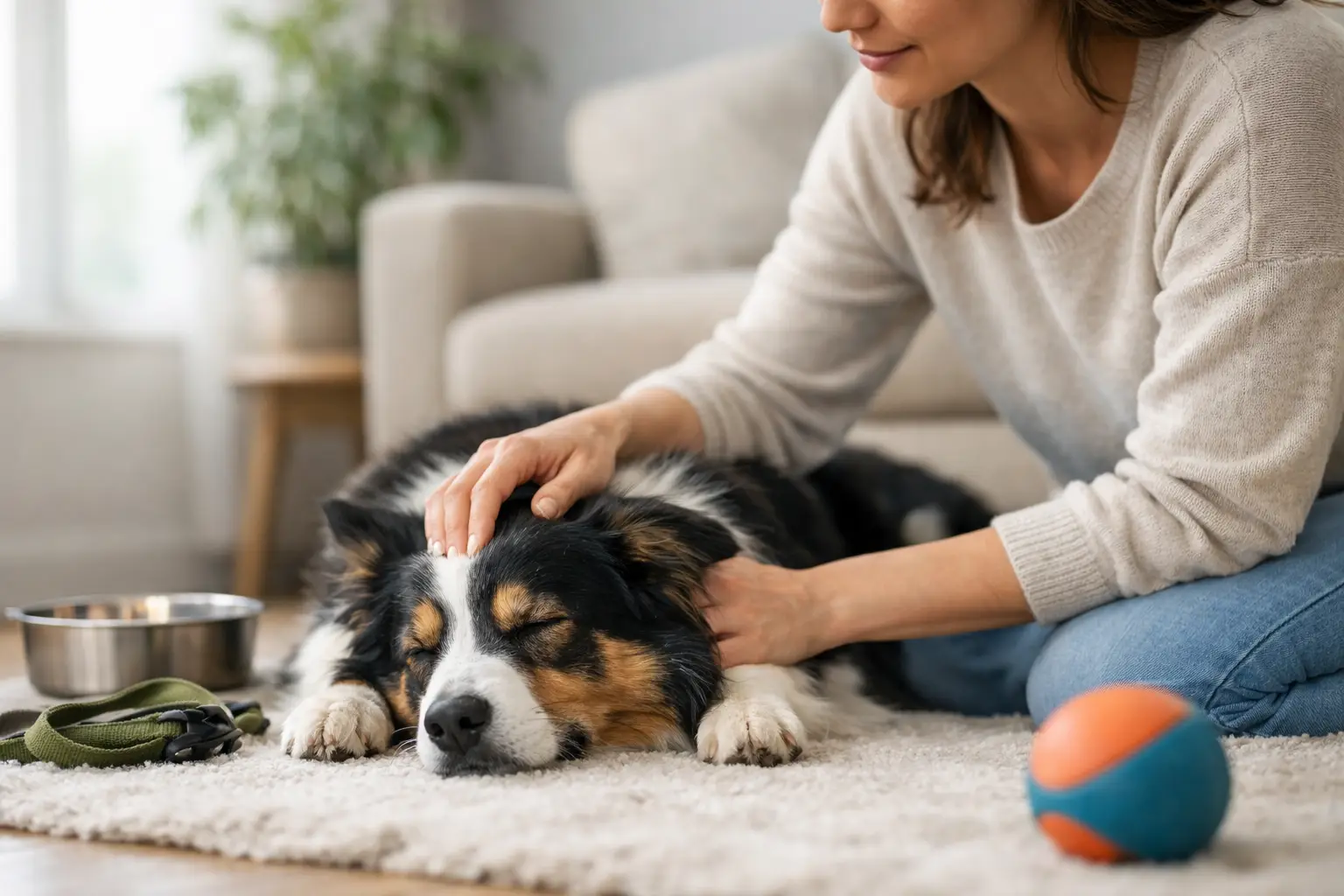
A doorbell rings, your dog explodes into barking, and the visitor is gone 30 seconds later. The trigger has ended, but your dog is still pacing, scanning the window, grabbing at your clothes, or barking at the next small sound. This is where a dog trigger recovery routine matters most.
Many owners focus only on stopping the first reaction. They try to interrupt the barking, pull the dog away from the window, or repeat a cue louder. But the minutes after the trigger often determine whether your dog settles or carries that stress into the rest of the day.
Recovery is not a reward for being worked up. It is a practiced process that teaches your dog, “That event is over. You can return to calm.”
What recovery after a trigger actually means
A trigger is anything that pushes your dog into a higher state of arousal. It may be the delivery truck, a person at the door, another dog on a walk, kids coming home from school, or the sight of movement outside the front window.
A dog does not always return to baseline simply because the trigger disappears. Adrenaline and emotional intensity can linger. Some dogs recover in a minute. Others need 15 minutes, an hour, or a quieter rest of the day. The time depends on the dog, the trigger, how close it was, and what else has already happened that day.
Think of recovery as the space between the reaction and the next demand. Your job is not to force instant calm. Your job is to lower stimulation, give your dog a familiar action, and reinforce the first signs that their body is coming back down.
That is especially useful for dogs who seem fine until the evening, then become restless, mouthy, jumpy, or unable to settle. Those behaviors are often not random. They can be the result of several unrecovered arousal spikes stacking up all day.
The dog trigger recovery routine: Notice, Reset, Reward, Release
A useful routine has to be simple enough to use when life is loud and you are distracted. Rubyjo K9 uses a practical behavioral loop: Notice → Reset → Reward → Release. You can apply it after a window-barking episode, a hard guest greeting, a tense walk, or pre-walk excitement.
Notice the recovery gap
First, notice what your dog looks like after the trigger is gone. Do not judge the reaction in the moment. Observe it.
Are they still staring toward the door? Panting when they are not hot? Pulling hard toward the window? Repeatedly checking the same area? Unable to take food? Those are signs that your dog may still be over threshold, meaning they are too activated to make calm choices easily.
Also notice the earliest signs of recovery. Your dog may turn their head away from the trigger, sniff the floor, soften their body, take a drink, lie down, or offer eye contact. These small changes matter. They are the moments you can build on.
Reset the environment before asking for behavior
A reset is not a punishment or a correction. It is a clear change that makes calm more possible.
After a doorbell incident, that might mean closing the blinds, moving away from the front room, and taking your dog to a quieter space. After a difficult dog sighting on a walk, it may mean calmly creating distance, crossing the street, and letting your dog sniff in a low-traffic area instead of continuing down the same busy route.
Keep your own movement boring. Fast talking, repeated commands, leash tension, and frustration can add more pressure to an already activated dog. Use fewer words. Slow down. Give your dog a predictable next step.
For some dogs, a brief decompression activity helps: scatter a few pieces of food in the grass, offer a lick mat after the environment is quiet, or let them sniff around the yard. For others, food keeps them too excited. In that case, a calm room, water, and time may be the better reset.
Reward the downshift, not the intensity
When your dog gives you a small sign of settling, reinforce it. You are not paying them for barking, lunging, or jumping. You are marking the choice that comes after the reaction: looking away, turning back to you, standing with a softer body, or taking a breath before moving.
The reward should match the moment. A small food reward placed low and calmly can work well. Quiet praise may suit a dog who is already sensitive to food excitement. Access to sniffing, a chew, or a favorite resting place can also be rewarding.
Avoid turning recovery into another high-energy game. Tossing a toy, excited praise, or a rapid stream of treats can keep some dogs elevated. The goal is not distraction at any cost. The goal is a genuine downshift.
Release back to normal life carefully
Release means your dog can return to a manageable version of normal life. It does not always mean going straight back to the exact situation that overwhelmed them.
If your dog barked at the window, release might mean a quiet settle in another room rather than reopening the blinds five minutes later. If they had a tough moment near another dog, release may mean finishing the walk on an easier route, not looping back for another close pass.
This is where owners often move too fast. They see two seconds of calm and immediately test the dog again. That can restart the whole cycle. Let recovery be real before you add another challenge.
Build the routine before the hard moments
A recovery routine works best when it is familiar. Do not wait for the biggest reaction of the week to introduce a mat, a quiet room, or a scatter-and-sniff reset.
Practice the same sequence after mild, everyday excitement. Use it after your dog greets a family member, comes in from the yard, finishes a short play session, or hears a low-level noise outside. The goal is to make settling a normal transition, not an emergency procedure.
Choose one recovery location if possible. A bed in the bedroom, a mat behind a baby gate, or a quiet corner of the living room can become a clear cue that activity has ended. The space should not feel like isolation or punishment. It should be predictable, comfortable, and low-stimulation.
Consistency matters more than length. A two-minute reset used most days is more useful than a 30-minute training session you only manage once a week.
Track what helps your dog recover faster
You do not need a complicated behavior journal. A simple note can show you patterns that are easy to miss when you are living through busy days.
After a trigger, record what happened, how intense the response was, what reset you used, and roughly how long it took for your dog to show a softer body or settle. You may find that evening window barking is worse after a crowded walk, or that your dog recovers much faster when you block visual access before they begin rehearsing the behavior.
Progress is not measured only by whether your dog reacts. A dog who still barks but turns away sooner, accepts a reset, and settles in five minutes instead of 25 is making meaningful progress.
When a routine is not enough on its own
Recovery work is valuable, but it does not replace management, skill building, or professional support when safety is a concern. If your dog is biting, redirecting onto people or other pets, panicking, or unable to recover for long periods, speak with a qualified force-free trainer and your veterinarian. Pain, illness, and chronic stress can affect behavior.
It also helps to reduce repeated exposure while you train. If your dog spends all afternoon rehearsing window barking, recovery will be harder. Block the view, use white noise, adjust walk timing, or create distance from predictable triggers. Management is not failure. It gives training room to work.
Your dog does not need a perfect day to learn a calmer pattern. They need enough repetition of one clear message: the trigger can end, the pressure can come down, and there is a safe next step waiting.
Safety note
Safety note: if your dog shows aggression, intense fear, bite risk, pain, sudden behavior change, or medical concerns, contact a qualified professional or veterinarian before pushing the routine harder. This article is educational and is not a substitute for individualized behavior or veterinary care.