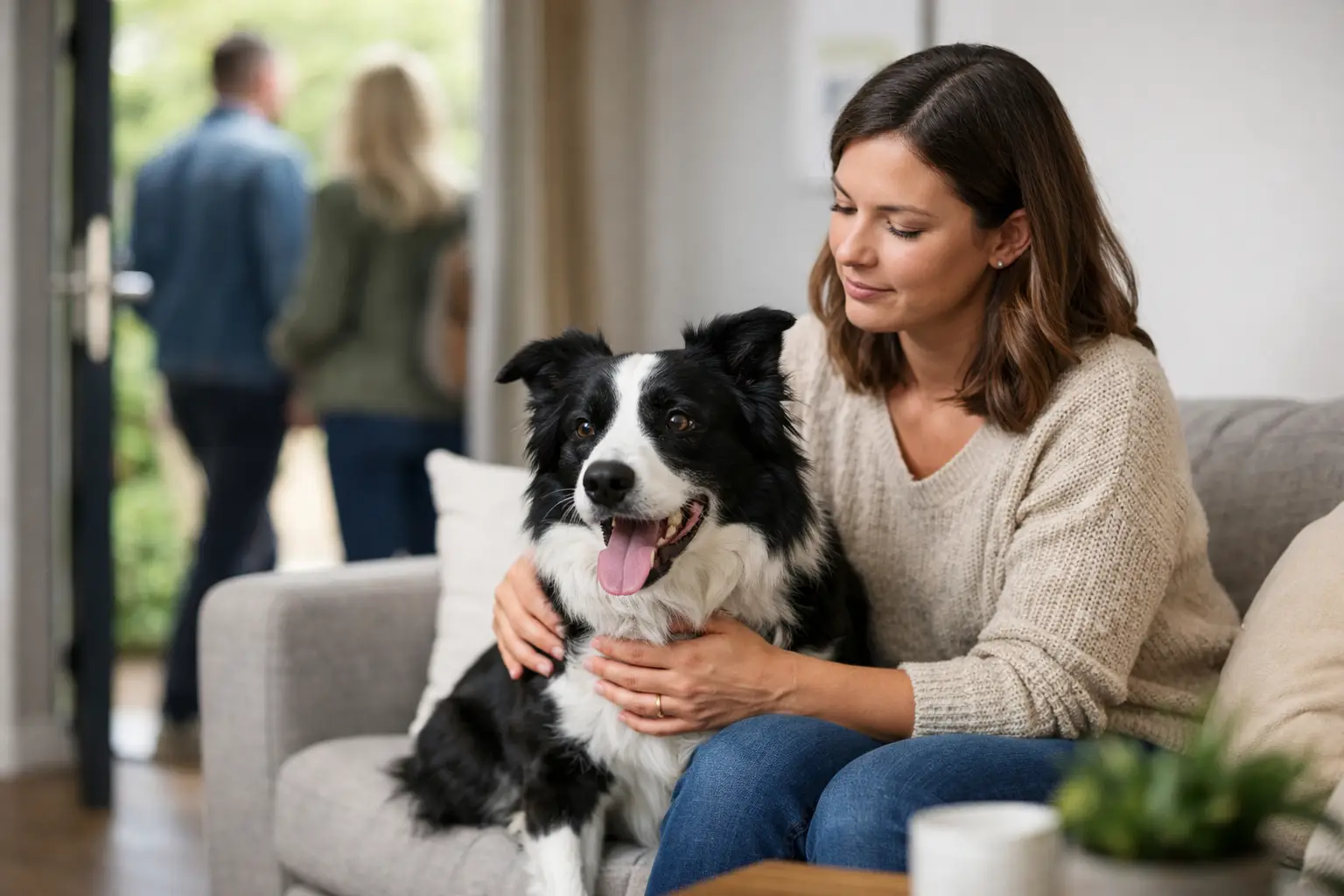
The hard part is not always the knock at the door. For many dogs, the real struggle starts after the visitors sit down. Your dog keeps pacing, whining, scanning the room, grabbing toys, jumping back into greetings, or barking every time someone shifts in their seat. If you want to reduce dog arousal after visitors, you need a plan for the recovery period, not just the front-door moment.
This is where a lot of owners get stuck. They work on the greeting, maybe even get through it reasonably well, and then assume the dog should settle on their own. But a dog that was pushed over threshold by the arrival often cannot smoothly come back down without help. Excitement leaves a residue. That leftover energy shows up as restless behavior long after the door closes.
Why dogs stay amped up after guests arrive
Visitors change the whole picture for a dog. There is movement, novelty, scent, eye contact, talking, and usually a shift in the household rhythm. Even social dogs can have trouble regulating after that kind of event. The issue is not always friendliness or fear in isolation. Often it is arousal itself - the dog is simply too activated to make good choices.
That matters because arousal is not just visible excitement. It affects decision-making, impulse control, and recovery speed. A dog who can hold a sit in a quiet kitchen may completely lose access to that skill when guests are present. That does not mean the dog is stubborn or dominant. It usually means the environment got bigger than the dog’s current coping skills.
There is also a timing problem. Many owners wait until the dog is already pacing laps around the coffee table before stepping in. At that point, the dog has practiced several minutes of frantic behavior. It is much easier to interrupt the rise than to clean up a full spike.
Reduce dog arousal after visitors by managing the first 10 minutes
The first 10 minutes after entry are often the most important. That is the window where your dog either keeps climbing or starts coming down.
Start by lowering the overall intensity of the room. Keep greetings brief. Ask visitors to ignore the dog at first, especially if your dog gets more wound up from eye contact, baby talk, or repeated reaching. Friendly attention can still be too much attention.
Then give your dog a clear job. This could be settling on a mat, moving to a gated space with a chew, or staying on leash beside you while the room settles. The exact setup depends on your dog, but the principle stays the same. Do not leave the dog in a vague state of freedom and hope they figure it out.
A good recovery plan follows a simple loop: notice the early signs of escalation, reset before the dog spins up further, reward the calmer choice, then release when the dog is actually ready. That sequence is much more effective than repeating cues while the dog ignores you.
What arousal looks like before it turns into chaos
Arousal does not always look dramatic at first. Sometimes it starts as fast sniffing, darting from person to person, inability to hold still, closed mouth tension, repeated toy grabs, or checking the windows and hallway every few seconds. Some dogs lean into visitors and then ricochet away. Others look busy rather than wild.
These small signals matter. If you only intervene once barking or jumping starts, you are late. Early interruption is not punishment. It is support.
This is why structured observation helps so much. Instead of asking, "Is my dog being good?" ask, "Is my dog getting calmer or getting more activated?" That question gives you something useful to act on.
The best way to reduce dog arousal after visitors is a short reset routine
Most busy households do better with a repeatable routine than with improvised training. Your dog does not need a different strategy every time Aunt Lisa comes over. They need a pattern they can recognize.
A practical reset routine might look like this: your dog greets briefly if appropriate, then transitions to a mat or behind a gate, gets rewarded for orienting back to you, and stays there long enough for their breathing and movement to soften. If they start escalating, you calmly reset again instead of arguing with the behavior.
The reset itself should be simple. Guide the dog back to the station, reduce stimulation, mark the calmer moment, and reinforce it. Then wait. Owners often rush the release because the dog looks "mostly fine." Mostly fine is often still too high.
This is one of the biggest trade-offs to understand. If you release too early, the dog rehearses another spike and the whole process takes longer. If you hold structure just a bit longer, recovery usually gets smoother from one visit to the next.
Set up the environment so your dog can succeed
Training is easier when the room is not working against you. If your dog tends to orbit visitors, block access to the main seating area at first. If visual scanning increases arousal, close blinds or reduce open-door traffic. If your dog gets pushier when people move around with food or bags, control those transitions instead of expecting perfect self-control in the middle of them.
Leashes, gates, mats, and food-based reinforcement are not shortcuts. They are tools that create enough structure for learning to happen. Many owners abandon management because they want the dog to be "naturally calm." But calm is usually built through repetition, not wished into existence.
It also helps to think about duration. Some dogs can handle a two-minute greeting and then need 20 minutes of decompression. Others need to skip greeting entirely and settle first. There is no prize for doing the hardest version right away.
What to do when visitors want to interact
This is the part that trips people up. Guests often mean well, but they accidentally keep the dog activated. They call the dog over, pet in quick bursts, laugh when the dog jumps, or encourage toy chasing in the living room. Then the owner is left trying to calm a dog who just got recharged.
Be direct and simple. Tell visitors your dog settles faster when ignored at first. Give them one instruction, not five. Something like, "Please let him relax for a few minutes before saying hi" is enough for most situations.
If your dog is highly social, controlled interaction can be part of the plan. But make it earned and brief. A few seconds of calm contact followed by a return to the mat is much better than ten minutes of nonstop stimulation. Interaction should not be the reward for frantic behavior.
When progress feels slow
If your dog still struggles, that does not mean the training is failing. It usually means one of three things. The environment is too hard, the reset is happening too late, or the dog has not had enough repetition at a lower intensity.
This is where owners often get tempted by random fixes. They try a new cue, a different treat, a stronger correction, or advice from six different videos. That usually adds confusion, not progress.
A steadier approach works better. Keep the routine the same for several visitor reps and track what actually changes. Did barking drop from ten minutes to four? Did pacing stop sooner? Was your dog able to settle behind the gate without vocalizing? Those are meaningful wins, even if the dog is not perfect yet.
Rubyjo K9 teaches this kind of household progress for a reason. Real behavior change is easier to sustain when you have one clear sequence to repeat instead of a pile of disconnected tips.
Common mistakes that keep dogs overstimulated
The most common mistake is asking for too much freedom too soon. Another is talking too much during the spike - repeating cues, negotiating, or getting frustrated. That extra energy often adds pressure to an already overloaded dog.
A third mistake is rewarding intensity by accident. If your dog jumps, whines, and pushes into guests until someone finally pets them, the dog learns that persistence works. That does not make your dog manipulative. It just means behavior is doing its job.
Finally, many owners focus only on stopping the obvious behavior and skip recovery entirely. A dog can stop jumping and still be internally over-aroused. If you want calmer evenings after guests arrive, the goal is not just outward control. The goal is a real return to baseline.
What calm progress actually looks like
Calmer does not always mean sleepy. It may mean your dog can lie down, take food gently, look at a guest without surging forward, and recover when someone stands up. Those are strong signs of regulation.
Some visits will still be messy. New people, kids, louder homes, or longer stays can raise the difficulty. That is normal. The answer is not to scrap the process. It is to scale the setup to match the challenge.
If your dog gets wound up after visitors, think less about stopping behavior in the moment and more about building a reliable landing pattern. Notice the rise, reset early, reward the calmer choice, and release only when your dog is truly back with you. That is how busy households get more peace without turning training into a second full-time job.
Safety note
Safety note: if your dog shows aggression, intense fear, bite risk, pain, sudden behavior change, or medical concerns, contact a qualified professional or veterinarian before pushing the routine harder. This article is educational and is not a substitute for individualized behavior or veterinary care.