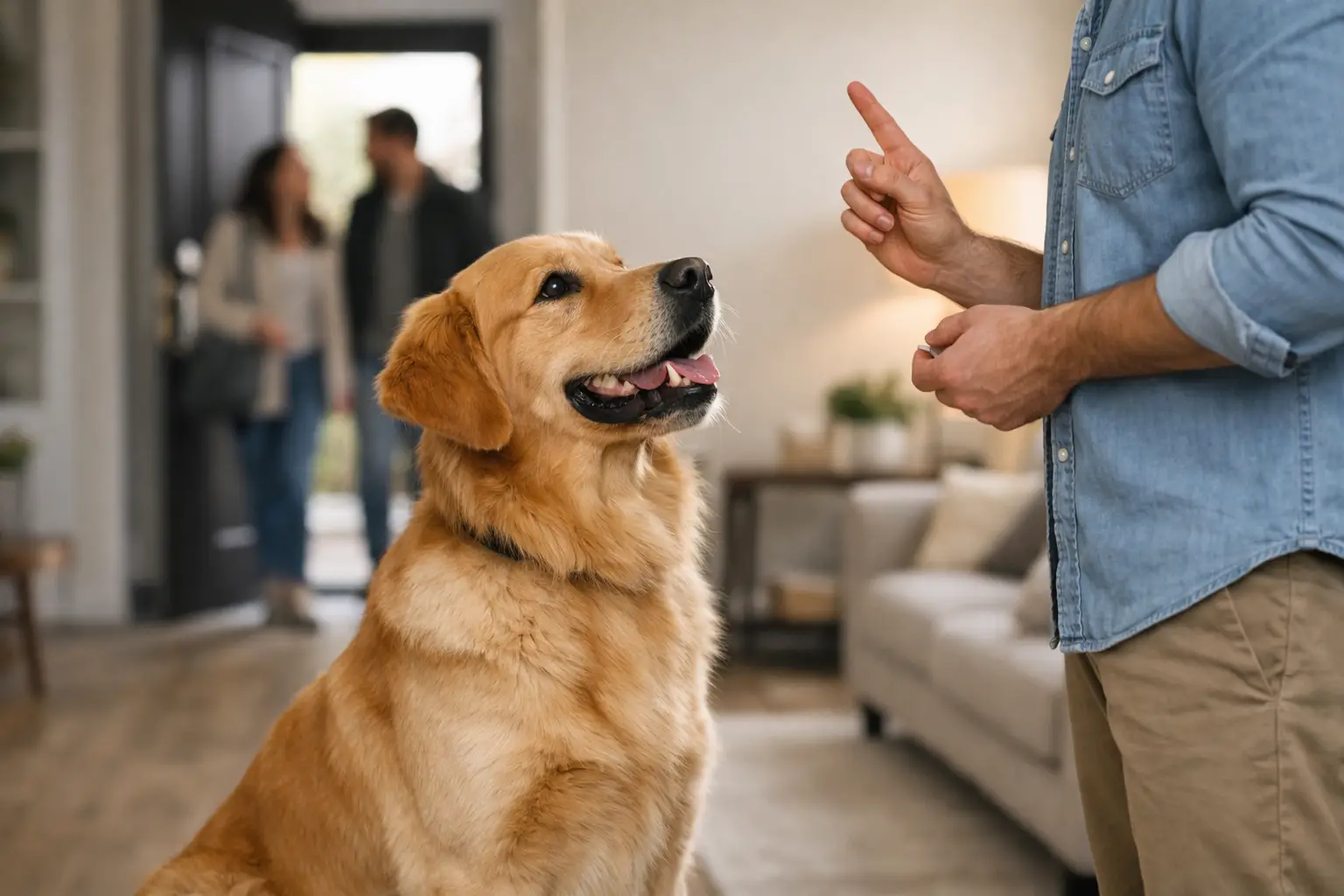
The doorbell rings, your dog launches toward the entryway, and suddenly you are trying to greet a friend while blocking jumping, barking, and frantic pacing. The best time to train dog before guest arrivals is not when someone is already standing at the door. It is during the quiet minutes and practice sessions that teach your dog exactly what happens next.
Guest greetings create a high-arousal chain: a sound at the door, fast movement, unfamiliar voices, eye contact, and the possibility of attention. For an excitable or reactive dog, that chain can overwhelm their ability to listen. Your goal is not to force a perfect greeting. Your goal is to build a repeatable routine that keeps your dog under threshold and gives you control of the space.
Start with a guest-arrival plan, not a last-minute correction
Many owners wait until the dog barks or jumps, then repeat commands over the noise. That is understandable, but it puts training at the hardest point of the event. A dog who is already racing toward the door is usually too stimulated to learn much from a new instruction.
Instead, decide what a successful arrival looks like in your home. It may be your dog resting behind a gate while visitors enter. It may be a dog on a mat across the room, chewing a food toy. For some dogs, especially those that are fearful or reactive, success may mean staying in a quiet bedroom during the entire visit.
That is not a failure. A calm separation plan is often safer and kinder than insisting your dog greet every person who walks in.
Use the same basic behavioral loop each time: Notice, Reset, Reward, Release. Your dog notices the trigger, you guide them back to a known behavior, you reward calm choices, and you release them only when they are ready. Repetition turns this from a stressful scramble into a familiar household routine.
Build the skills before you add real guests
Teach a station that is easy to repeat
Choose one location away from the front door: a bed, mat, crate, or gated area. This is your dog's station. It should predict calm food rewards, chews, and low-pressure downtime, not punishment or isolation.
Begin when nothing is happening. Walk your dog to the station, reward them for stepping on it, then reward again for staying there for a few seconds. Gradually add duration. If your dog gets up, calmly guide them back and make the next repetition easier.
Practice for two to five minutes at a time. You are looking for relaxed body language: softer eyes, a lower head, slower breathing, and the ability to take food gently. A dog who can hold a stay while staring, whining, or trembling may be physically still but not emotionally settled. Lower the difficulty until calm is possible.
Practice the sound without the full event
The doorbell often becomes a starting gun because it reliably predicts excitement. You can change that prediction through short, controlled repetitions.
Use a doorbell recording, a knock sound, or a family member tapping lightly on the door. Play the sound at a low level, then immediately cue your dog to their station or scatter a few treats away from the entry. Reward the reset, not the explosion.
If your dog barks once and then turns back to you, that is progress. If they cannot hear you, will not take food, or sprint to the door, the practice was too difficult. Reduce the volume, increase distance from the door, or begin with a softer sound.
Do not practice until your dog is exhausted or frustrated. Three to six calm repetitions are more useful than twenty chaotic ones.
Add movement in small pieces
Guests do not just make noise. They walk up, talk, enter, set down bags, and make eye contact. Break that sequence apart before asking your dog to handle all of it.
Have a helper stand outside while your dog stays on their station. Then practice the helper opening the door, stepping inside, and sitting down. At first, your helper should ignore the dog completely. No reaching, talking to them, or enthusiastic eye contact.
Once your dog can remain calm through entry, you can decide whether a greeting is appropriate. Some dogs do well with a brief, structured hello after they have settled. Others become more excited the moment they are released. Let your dog's behavior, not social pressure, determine the plan.
Your 10-minute routine before guests arrive
When you know people are coming over, give yourself a buffer. Do not wait for the text that says, “I’m here.” A short preparation routine can prevent the first arousal spike from taking over the whole visit.
Start with a bathroom break and a calm sniff walk or quiet yard time. This is not the moment for fetch, wrestling, or high-speed play. Intense exercise can leave some dogs more activated, not less. Choose decompression over hype.
Next, remove the predictable friction points. Close blinds if window barking is likely. Put your dog's leash, treats, and a long-lasting chew near the station. Set up a gate, crate, or closed room before the knock. If your dog needs medication or a veterinarian-supported calming plan, follow that plan well before guests arrive.
Then do two or three easy station repetitions while the house is still quiet. Reward generously for choosing the mat, settling their body, and looking back at you. You are reminding your dog of a familiar answer before the question gets hard.
Finally, tell your guests what to do. A simple message works: “Please come in and ignore the dog for a few minutes while they settle.” Good guests usually appreciate clear instructions. You are not being difficult. You are protecting your dog's training and everyone's comfort.
What to do when the guest is at the door
When the arrival cue happens, move through the same sequence without rushing. Notice the trigger. Ask for the station or guide your dog behind the gate. Reward the first calm choice you can get. Then open the door only when your dog is safely managed.
If your dog barks, avoid turning the moment into a shouting match. Barking is information: the trigger is currently too intense. Create more distance, close the door if needed, and return to an easier version of the routine. Your dog does not need a lecture. They need help recovering.
Keep greetings short. If you release your dog to say hello, use a leash or drag line when appropriate, and ask the guest to stand still. Reward four paws on the floor. If your dog jumps, calmly guide them away and reset rather than allowing repeated jumping followed by attention.
For dogs that become frantic around visitors, skip the greeting entirely. Give them a chew in their safe space and let the household settle first. You can reassess later, but there is no prize for rushing exposure.
Common mistakes that keep door chaos going
The biggest mistake is practicing only during real arrivals. Real life is useful for testing skills, but it is not the best place to teach them from scratch. Use planned practice so you can control the sound, distance, and duration.
Another mistake is asking for a long stay before the dog has learned to settle. A station should be built gradually. If your dog can only manage ten seconds today, reward ten successful seconds. Duration comes after understanding.
It also helps to avoid accidental rewards for jumping. If a guest laughs, pets the dog, or says hello while the dog has paws on their body, the jumping has worked. Ask visitors to give attention only after your dog is grounded and calmer.
Finally, do not measure success only by silence. A quiet dog who is frozen, panting, or unable to eat may still be stressed. Look for recovery: Can your dog return to the mat? Can they take a treat? Can they soften after the guest sits down? Those are the useful signs that the routine is working.
Track progress by recovery, not perfection
Guest training improves through small wins. Keep a simple note after each visit: how long barking lasted, whether your dog reached the station, how quickly they could take food, and whether they recovered after the initial trigger. This gives you a clearer picture than relying on the feeling that the visit was “good” or “bad.”
Rubyjo K9 uses this kind of practical tracking because household behavior changes when owners can see the pattern, adjust one variable, and repeat the right step tomorrow. If the routine falls apart, make the next practice easier. More distance, a quieter knock, a shorter visit, or a stronger management setup can all create a successful repetition.
A calm guest arrival is built one ordinary practice at a time. Set up the space, protect your dog's threshold, and reward the recovery you want to see. The next knock does not need to be perfect. It only needs to be a little more manageable than the last one.
Safety note
Safety note: if your dog shows aggression, intense fear, bite risk, pain, sudden behavior change, or medical concerns, contact a qualified professional or veterinarian before pushing the routine harder. This article is educational and is not a substitute for individualized behavior or veterinary care.