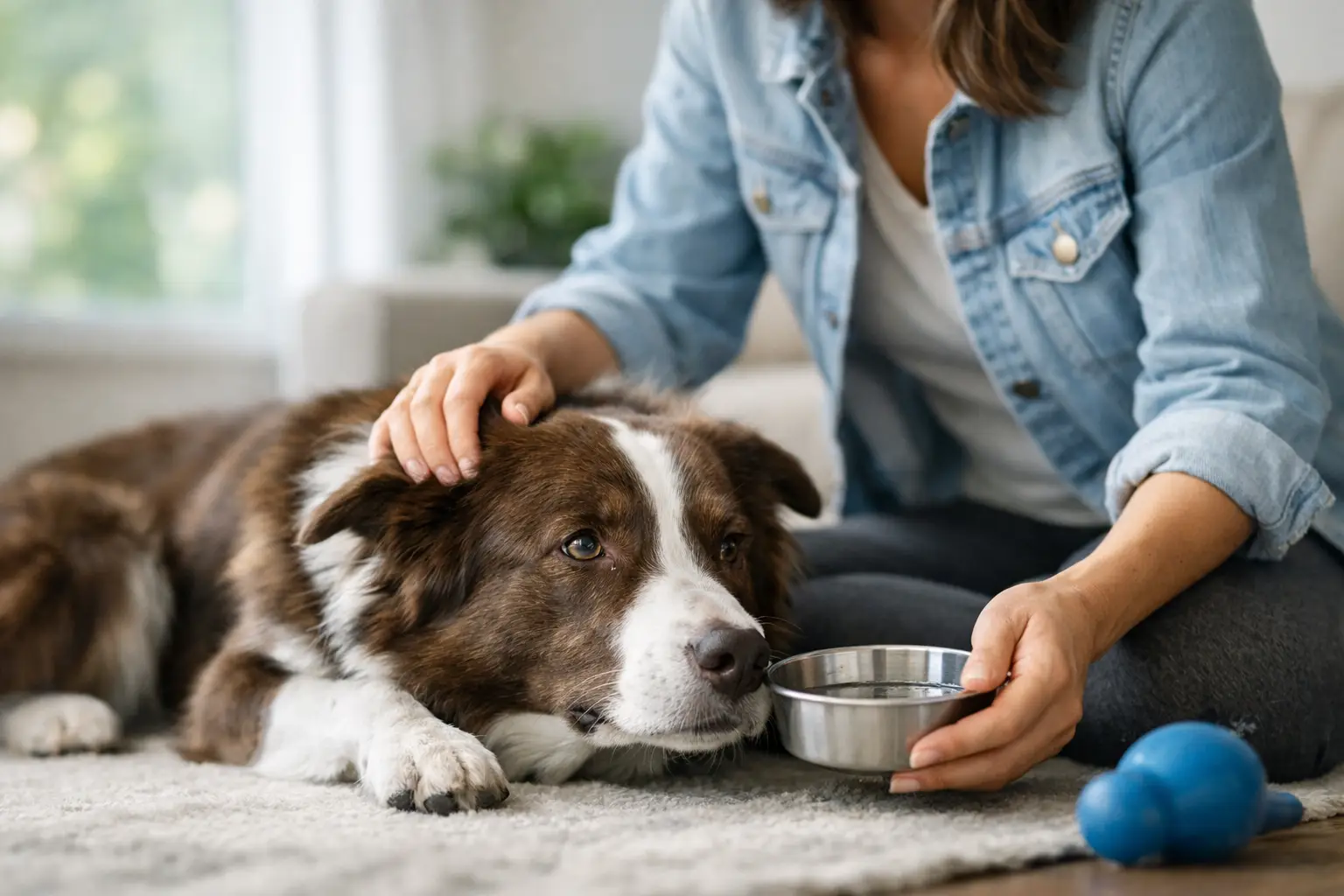
The hard part usually is not the bark, lunge, spin, or explosion itself. It is what happens in the two minutes after. If your dog tips over threshold at the window, loses it on a walk, or goes airborne when guests arrive, a solid dog reset routine after trigger moments gives you something useful to do next instead of guessing.
That matters more than most owners realize. A triggered dog does not snap back to normal just because the mail truck left or the other dog passed by. The body is still activated. The brain is still busy. If you move straight into more excitement, more exposure, or a lot of frantic talking, you often get a second reaction layered on top of the first.
A reset routine is not punishment, and it is not avoidance forever. It is a short, repeatable recovery process that helps your dog come down enough to think again. For busy households, that is often the difference between one rough moment and a whole evening of chaos.
What a dog reset routine after trigger really does
After a trigger, many dogs are not making good decisions. They are scanning, pacing, whining, barking at the next sound, pulling harder, or ricocheting into the next problem behavior. Owners often read that as stubbornness or defiance. More often, it is leftover arousal.
A good reset routine interrupts that chain. It lowers pressure, reduces stimulation, and gives the dog a familiar sequence to follow. Familiar matters here. When the pattern is consistent, your dog starts to recognize, "We had a hard moment, now we do this." That predictability supports recovery.
This is also where many training plans break down. People spend time working on the trigger itself, which is important, but they ignore recovery. Then they wonder why the dog seems fine one minute and impossible the next. If recovery is messy, progress stays messy.
The simple reset framework
At Rubyjo K9, the most useful household routines follow a straightforward loop: Notice, Reset, Reward, Release. That same structure works well after a trigger because it keeps you from overcomplicating the moment.
Notice
First, notice what actually happened. Not your interpretation, just the observable facts. Your dog barked at the door. Froze at a person. Lunged at another dog. Spun and grabbed the leash. This step sounds basic, but it keeps you from escalating with emotion. Calm observation helps you respond instead of react.
Reset
Then create recovery conditions. Increase distance if needed. Move away from the window. Step off the path. Guide your dog to a quieter room. Slow your own body down. Use fewer words. The point is not to force perfect obedience in a hot moment. The point is to reduce input so the nervous system can settle.
Reward
When your dog offers any workable sign of recovery, mark it with something meaningful. That might be a soft glance toward you, four paws on the floor, a slower breath, following you calmly, or taking food again. Reward the return of thinking, not just formal commands.
Release
Once your dog is back under control, release into an appropriate next step. Sometimes that means returning to normal life. Sometimes it means ending the walk, switching to a sniffy decompression route, or giving your dog a quiet chew behind a baby gate. Release should match your dog's current capacity, not your original plan.
What to do right after the trigger
Most owners need a practical sequence, so here it is in real-life terms. Keep it short and repeatable.
Start by getting your dog out of the trigger picture. That may mean turning and walking away, closing curtains, stepping behind a parked car, or guiding your dog into another room. Distance is not quitting. It is how you create the conditions for learning to return.
Next, settle yourself before you try to settle your dog. If your voice gets sharp, your leash gets tight, and your movements get fast, your dog usually stays activated longer. One quiet breath and slower hands can change the whole feel of the moment.
Then ask for very little. This is where people often ask for too much too soon — a perfect sit, a long down, eye contact, heel position. If your dog is still buzzing, those requests often fail and add frustration. Start smaller. Can your dog follow you three steps? Can they orient toward you for one second? Can they sniff the ground and exhale?
Once you see that small recovery sign, reward it. Use food if your dog can eat. If they cannot take food yet, that tells you arousal is still high and you need more time or more distance. For some dogs, calm praise helps. For others, silence and space work better. It depends on the dog.
Finally, choose the next activity carefully. Going straight from a fence fight to rough play in the yard is usually a bad trade. Going from a chaotic greeting to a quiet mat with a scatter of treats is often a much better one.
The biggest mistakes owners make
One common mistake is treating the trigger event as over the second the stimulus disappears. The dog may still be carrying that event in their body for several minutes or longer. If you stack another challenge too quickly, you get a faster and bigger reaction.
Another mistake is talking too much. When owners are stressed, they often fill the space with repeated cues, reassurance, or correction. "It's okay, leave it, stop, no, sit, come here, relax." Most of that becomes noise. Clear action beats extra language.
A third mistake is rewarding too late. If you wait until your dog is fully settled for thirty seconds, you may miss the meaningful turning point. Look for the first signs that the dog is coming back online and reinforce those.
The last big one is inconsistency. If one day you pull your dog away, the next day you scold, and the day after that you try a handful of internet tips, your dog never gets a stable recovery pattern. A reset routine works because it is boringly familiar.
How this looks in common household situations
If your dog explodes at the doorbell, the reset might be: guide away from the door, pause in a low-stimulation spot, reward for reorientation, then send to a mat or behind a gate before opening the door again. The key is not arguing at the front door while your dog is already over threshold.
If your dog loses it at the window, your reset might be: calmly block visual access, move your dog away, wait for breathing and body language to soften, reward the first calm check-in, then redirect to a known settle area. If the window remains active all day, management matters as much as training.
If the trigger happens on a walk, your reset might be: create distance, stop asking for precision, let your dog decompress with slower movement and simple food patterns, then decide whether to continue or head home. Some dogs can recover and keep going. Some cannot. Good handling means knowing the difference.
If guests cause the problem, do not rush your dog back into the social situation to "practice." Recovery first. Then decide whether your dog is ready for another controlled exposure or needs a quieter setup for the rest of the visit.
How long should a reset take?
There is no perfect number. Some dogs recover in thirty seconds. Others need ten minutes and a lower-stimulation environment. Breed tendencies, sleep, pain, age, trigger intensity, and trigger history all matter.
A useful rule is this: the dog is not reset when the behavior stops. The dog is reset when their body and choices look organized again. Softer eyes, looser movement, interest in food, ability to follow a simple cue, and reduced scanning are better markers than silence alone.
If your dog stays elevated for a long time after routine triggers, that is useful information. It may mean the trigger setup is too hard, the day is too full, or the dog needs a simpler plan with more management and lower criteria.
Build the routine before you need it
The best dog reset routine after trigger moments is practiced when life is easy. Do not wait for a full meltdown to introduce the pattern. Rehearse it after mild excitement, before meals, after coming inside, or when your dog hears a low-level sound and stays mostly functional.
That is how routines become available under pressure. Your dog learns the sequence in calmer moments, and you learn how little you actually need to say. Short repetitions beat marathon sessions here.
You can even keep the structure on paper if that helps. Notice the trigger. Reset the environment. Reward recovery. Release to the next appropriate activity. Consistency turns this from a nice idea into a dependable household skill.
A dog does not need you to solve everything in the moment. They need you to make the next minute simpler, calmer, and easier to succeed in. That is often where real progress starts.
FAQ
What is the fastest way to calm a dog after a trigger?
The fastest way to start lowering arousal after a trigger is to increase distance from the trigger and reduce stimulation. That usually means moving your dog away from the trigger source, slowing your own movements, and using fewer words. Do not rush into demands for perfect behavior. Let your dog orient toward something neutral, like sniffing the ground or following you a few steps, and reward that small recovery sign. If your dog cannot take food, that tells you arousal is still too high and you need more space or more time before trying again.
How do I know when my dog has fully recovered after a trigger?
A dog is not fully recovered when the barking or lunging stops. They are recovered when their body and choices look organized again. Key signs include softer eyes, looser body movement, interest in food, ability to follow a simple cue, and reduced scanning of the environment. Some dogs also show recovery by offering a shake-off, taking a deep breath, or stretching. If your dog is still stiff, scanning, or refusing food, they are not truly recovered even if they are quiet.
Should I avoid all triggers while teaching a reset routine?
Not permanently, but temporarily reducing exposure to known triggers helps the reset routine stick. If your dog is constantly over threshold, they never get a chance to practice recovery. Manage the environment to create more calm hours in the day, practice the reset sequence after low-level excitement, and only reintroduce harder triggers when your dog shows reliable recovery in easier situations. The goal is not to avoid triggers forever — it is to build a recovery skill that works when triggers happen.
Safety note
If your dog shows aggression, intense fear, bite risk, redirected biting, pain, sudden behavior change, or medical concerns, contact a qualified professional such as a certified force-free trainer or veterinarian before pushing the routine harder. This article is educational and is not a substitute for individualized behavior or veterinary care.