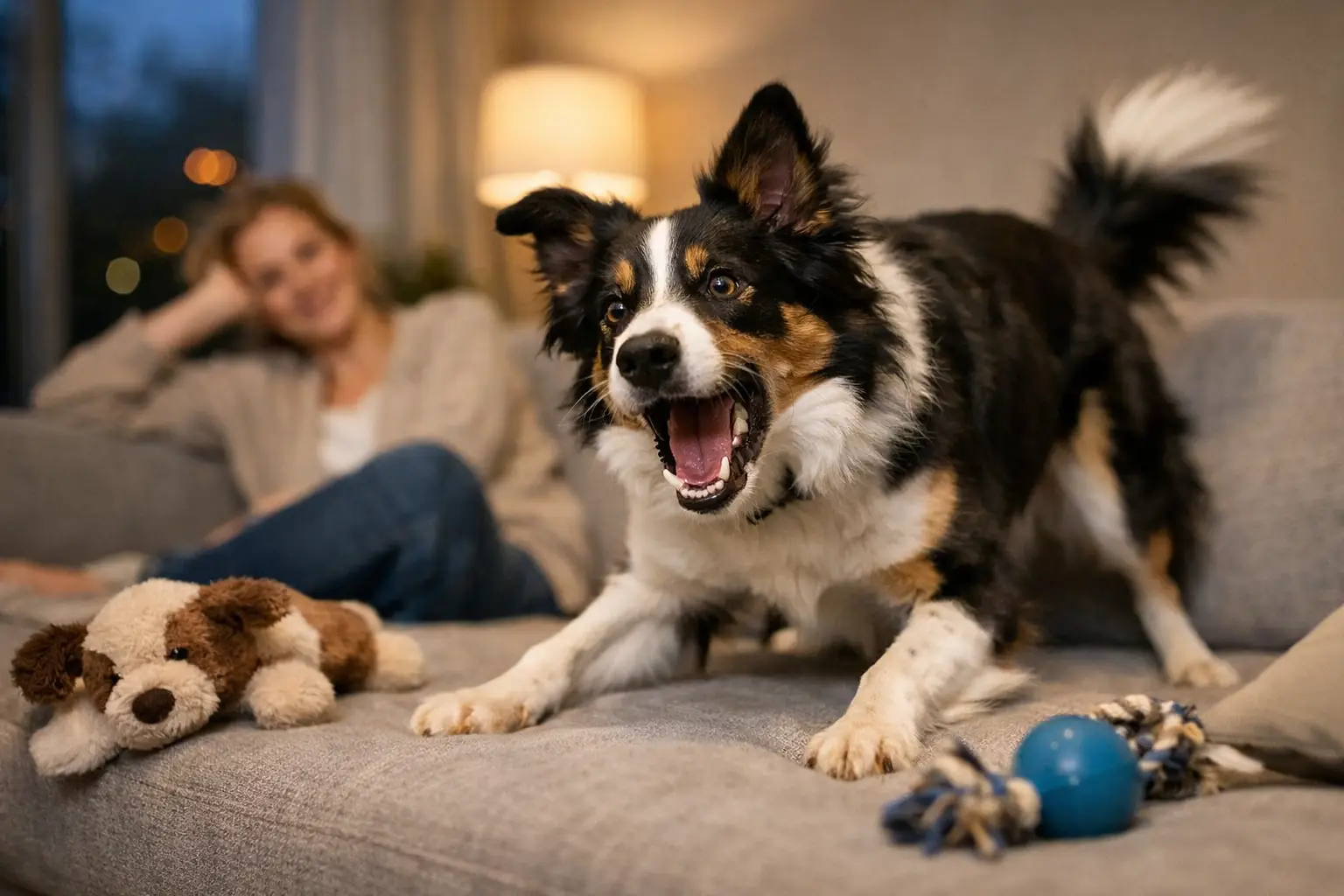
By 7:30 p.m., a lot of dogs seem to lose the plot. They pace, mouth, bark at nothing, launch off the couch, harass the other dog, and act like they have endless energy right when you have none left. If your dog is overstimulated in the evening, you are not dealing with a “bad” dog or a dog who needs to be worn into the ground. More often, you are seeing a nervous system that has stacked up too much input across the day and now has very little room left to cope.
That distinction matters, because it changes what actually helps. Evening chaos is rarely solved by adding more hype, more activity, or more correction. It improves when you start treating the pattern like an arousal issue, not a stubbornness issue.
Why a dog gets overstimulated in the evening
Most owners look at the 8 p.m. zoomies and assume the dog needs more exercise. Sometimes that is partly true. But a dog who gets overstimulated in the evening is often dealing with more than physical energy.
A typical day can quietly build pressure. The dog hears delivery trucks, watches squirrels through the window, gets excited before walks, barks when someone comes home, struggles to settle while people move around the house, and maybe misses quality sleep along the way. None of those moments seem huge on their own. Together, they create a dog who is running close to threshold by late afternoon.
Then evening arrives with its own triggers. Kids are louder. People are cooking. There is more movement in the house. The dog anticipates food, attention, play, or a walk. If guests come over or the doorbell rings, that can push the dog over the edge fast.
What owners often call “random evening craziness” is usually a very predictable stress-and-excitement pileup.
What overstimulation looks like at night
Some dogs get frantic and busy. Others get mouthy, demandy, or suddenly reactive. You may see relentless pacing, barking at small sounds, jumping on furniture, pestering people, grabbing clothes, nipping during play, or crashing hard after a wild burst.
It can also look deceptive. A dog may seem energetic, but the real issue is poor regulation. That means the goal is not simply to drain the dog. The goal is to help the dog come down, recover, and practice a calmer evening rhythm.
This is where many well-meaning owners get stuck. They respond to dysregulation with more stimulation. A rough game in the living room, endless ball throwing, or high-energy wrestling can make the dog look satisfied for ten minutes, then even more revved up after.
The biggest mistake: waiting until your dog is already spiraling
By the time your dog is ricocheting off the couch, you are late. Not doomed, but late.
Evening overstimulation is easier to change when you stop treating it as one bad moment and start treating it as a daily pattern with an early build. The most useful question is not “How do I stop this right now?” It is “What happens in the two hours before this?”
That is where progress starts.
A practical plan for a dog overstimulated in the evening
You do not need a two-hour protocol. You need a repeatable sequence that lowers friction for both of you. A simple structure works best because the evening is already busy. If you want a more step-by-step version, see the overstimulated dog at night routine.
Start by picking a consistent time window, usually 45 to 90 minutes before the dog typically gets chaotic. That is your intervention window. Inside that window, your job is to reduce trigger stacking and give the dog a predictable way to settle.
1. Notice the early signs
Do not wait for the explosion. Look for the small tells first. Your dog may start shadowing you, scanning the room, whining, getting grabby, staring at you for action, or reacting faster to normal sounds. That is the moment to step in.
This is where many owners accidentally miss their opening. They keep moving through chores while the dog gets more activated, then try to fix it once the dog is in full chaos. Earlier is easier.
2. Reset the environment
A dysregulated dog usually needs less input, not more. Close the blinds if window watching is part of the problem. Reduce rough play. Keep greetings low-key. If multiple family members tend to rile the dog up, ask for a quieter stretch of time.
This does not mean the house has to be silent. It means you stop adding avoidable fuel.
3. Offer a decompression activity, not a hype activity
The right evening activity depends on the dog. For some dogs, a slow sniffy potty break helps. For others, a food scatter, lick mat, chew, or short pattern game works better. The key is choosing something that encourages downshift, not adrenaline.
This is the trade-off owners need to understand. High-intensity fetch may look like a good energy outlet, but for a dog who is already near threshold, it can keep the nervous system cranked up. A calmer activity may seem less dramatic, yet it often works better because it supports recovery.
4. Reward calm before you ask for more of it
A lot of dogs never learn that calm behavior pays off inside the home. They learn that barking, jumping, or pestering gets attention fast.
So start paying for the moments you want repeated. If your dog lies down, exhales, softens, chooses a mat, or pauses instead of escalating, mark that with quiet reinforcement. The timing matters. You are teaching the dog that settling is worth doing.
5. Release thoughtfully
After a dog settles, many owners immediately bring the excitement back. They start a high-energy game, invite the dog onto the busiest part of the routine, or accidentally reward frantic behavior with sudden interaction.
Instead, think in short cycles. Calm, then release into something manageable. Not chaos, then collapse.
That basic loop - Notice, Reset, Reward, Release - is what makes evening training realistic. It gives you one clear action at each stage instead of a dozen disconnected tips.
Do dogs need more exercise or more recovery?
Sometimes both. But if your dog is overstimulated in the evening, adding more exercise without looking at recovery can backfire.
A dog with poor sleep, constant visual triggers, too much social excitement, or a frantic pre-walk routine may not need a harder day. That dog may need a better-structured day. Short training sessions, lower-arousal enrichment, predictable transitions, and protected downtime often change the evening more than trying to create exhaustion.
There is also a difference between productive exercise and frantic exercise. A thoughtful walk with sniffing, pattern, and decompression usually supports regulation better than a chaotic outing that leaves the dog more wound up than before.
When your evening routine is part of the problem
Owners are often surprised to learn they have accidentally built the pattern.
If the dog gets wild and then receives a ton of attention, the behavior gets rehearsed. If the family comes alive at night with loud play, repeated door traffic, and inconsistent boundaries, the dog has no clear path to settle. If the dog only gets meaningful interaction after acting out, the lesson is obvious.
This is not about blame. It is about seeing the pattern clearly enough to change it.
Your evening routine should answer three questions for the dog. What happens now? What am I supposed to do? What gets rewarded here? When those answers are fuzzy, dogs fill in the gaps with their own behavior.
How long does it take to improve?
If the pattern is mild, some owners see improvement within a week of becoming more proactive and consistent. If the dog has a long history of arousal spikes, poor settling skills, or multiple household triggers, it usually takes longer.
Measured progress is the right goal. Maybe the barking episode is shorter. Maybe the dog recovers faster. Maybe the pacing starts later, or the intensity drops from a 9 to a 6. Those changes count. They tell you the nervous system is getting more practice coming down.
Perfect evenings are not the first target. More recoverable evenings are.
When to get extra help
If your dog’s evening behavior includes redirected biting, fights between household dogs, panic-like behaviors, or intense reactivity that keeps escalating, get professional support. The same is true if your dog struggles to settle at any time of day, not just in the evening.
A structured plan matters here because random advice can make owners inconsistent. Rubyjo K9 focuses on the kind of short, repeatable household routines that reduce chaos without asking you to turn your life upside down.
Evening overstimulation can feel personal when you are tired and your dog is unraveling in the middle of the kitchen. It is not personal. It is a pattern. And patterns get easier when you stop chasing the last bad moment and start shaping the hour before it.
FAQ
Why does my dog get overstimulated in the evening?
Evening overstimulation usually comes from trigger stacking, missed rest, household activity, and anticipation around dinner, play, walks, or attention. The behavior can look like extra energy, but many dogs are actually past their comfortable coping point.
Should I exercise my dog more when they act wild at night?
Sometimes dogs need a better daytime outlet, but adding intense play after they are already frantic can make the pattern worse. Try earlier decompression, sniffing, quiet enrichment, and a short reset routine before the usual chaos window.
How do I calm an overstimulated dog without rewarding the behavior?
Step in before the full spiral when possible. Lower the environment, guide a simple reset, and reward the first sign of recovery such as a softer body, a pause, or a calmer choice. You are not paying for chaos; you are teaching the dog what to do next.
Safety note
If your dog is biting, redirecting onto people, showing aggression, suddenly changing behavior, or seems painful, pause home troubleshooting and contact your veterinarian and a certified force-free trainer. Evening overstimulation can be manageable, but safety and medical concerns need qualified help.
Safety note: if your dog shows aggression, intense fear, bite risk, pain, sudden behavior change, or medical concerns, contact a qualified professional or veterinarian before pushing the routine harder. This article is educational and is not a substitute for individualized behavior or veterinary care.