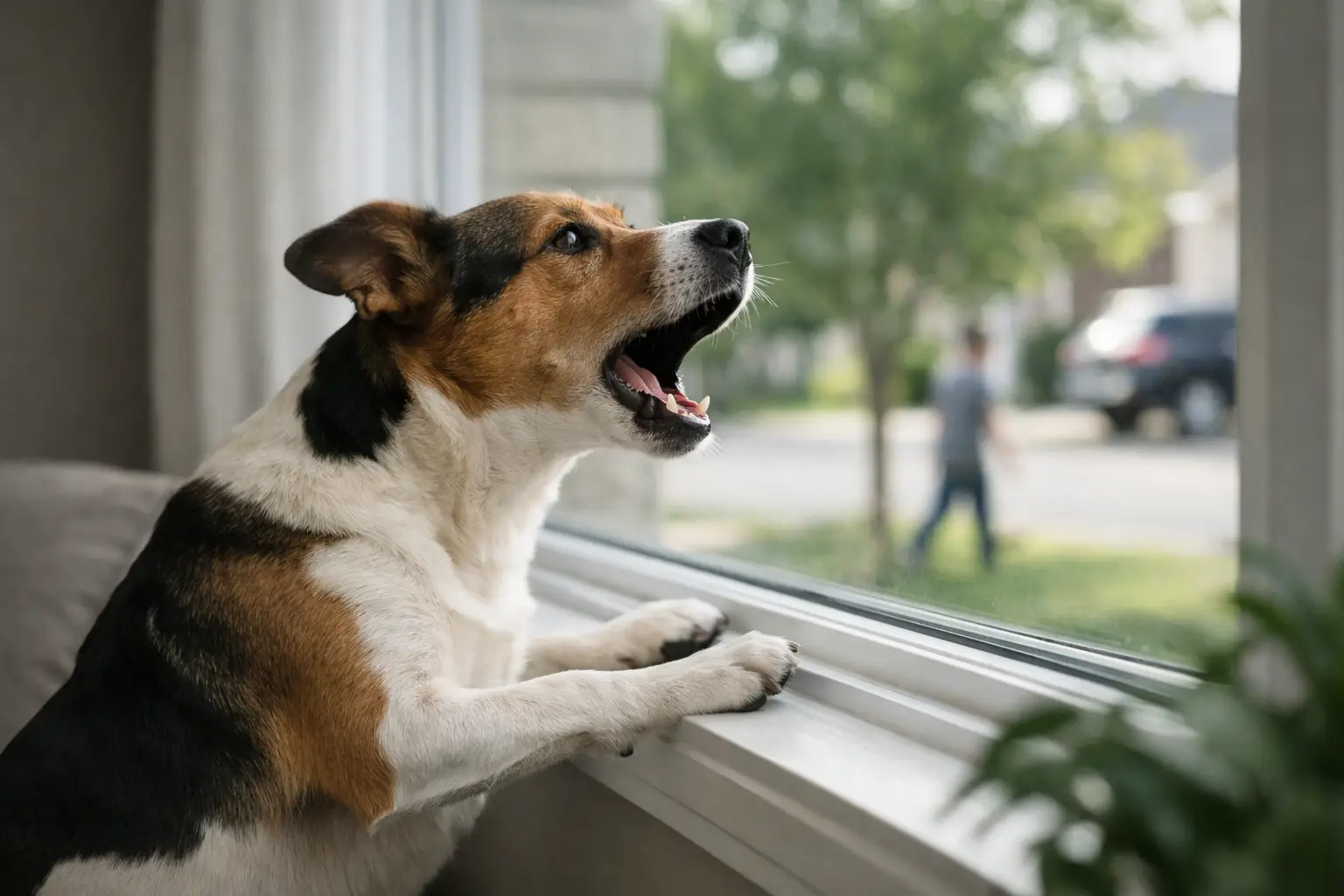
If your dog launches at the front window every time a person, dog, car, or delivery truck passes by, you are not dealing with a bad habit. You are dealing with a rehearsal loop. That is the first thing to understand about how to stop window barking. Your dog sees movement, their body spikes, they rush the window, they bark, and the trigger eventually disappears. To your dog, that can feel like barking worked.
That is why random corrections usually fall apart. Yelling from across the room, repeating "quiet," or dragging your dog away after they are already exploding does not teach a different pattern. What works better is a simple routine that changes what your dog does before, during, and after the trigger.
Why window barking gets stronger so fast
Window barking is rewarding. The visual trigger is intense, the burst of barking releases energy, and the person or dog outside keeps moving. Even if the trigger was never affected by your dog, the sequence still feels meaningful to them.
There is also a household pattern that often feeds it. Many dogs spend long stretches scanning windows with no guidance and no recovery routine. They practice going from neutral to frantic over and over. Some bark out of excitement, others out of frustration or territorial drive, but the result is the same: the behavior becomes fast and automatic.
How to stop window barking without creating more chaos
The goal is not to make your dog love every passing trigger. It is to lower the intensity, interrupt the sprint to the window, and build a reliable reset. That takes management first, then training.
Start by reducing the number of full-blown rehearsals your dog gets each day. If your dog spends hours posted at a picture window barking at every movement, training will be slower because they are practicing the exact behavior you want to change. Use frosted film, partial visual blockers, closed blinds, or gates that limit direct window access when you cannot actively train. This is not avoidance. It is stopping unpaid practice.
Use a simple behavior loop
A practical way to train this is to follow a repeatable loop: Notice, Reset, Reward, Release.
Notice means you catch the moment your dog becomes alert, before the full bark-and-charge sequence takes over. Maybe the ears lift, the body gets still, or your dog starts to lean toward the window.
Reset means you interrupt early and guide your dog into a simple behavior they know, such as turning toward you, moving away from the window, going to a mat, or coming to your side. The reset should be short and easy, not a complicated obedience drill.
Reward means you pay the calm choice quickly. Use food, praise, or a toss to a mat depending on your dog. Reward when your dog disengages and settles, not after a full barking fit.
Release means you decide what happens next. Sometimes that means your dog returns to normal life away from the window. Sometimes it means a brief, controlled look from a distance if they can stay under threshold. The point is that the window does not stay in charge of the routine. You do.
What to teach before the next trigger happens
If you only practice during real meltdowns, progress will feel uneven. Teach the pieces when your dog is calm so they are easier to use later.
A hand target, a recall off a low-level distraction, a mat settle, or a simple "this way" turn can all work as your reset behavior. Pick one or two that fit your home and practice them in short sessions. For many households, a mat near but not directly against the window works well. The mat becomes the place your dog moves to when they notice something outside. At first, reward heavily for choosing the mat with no trigger present. Then practice with mild movement outside at a distance.
Start where your dog can notice the outside world without instantly unraveling. If your dog is already slamming the window and barking hard, you are too late for clean learning in that rep. This is one of the biggest mindset shifts in how to stop window barking: success usually happens before the big reaction, not during it.
What to do in the moment
When a real trigger appears, keep your movements calm and direct. The second your dog notices it, cue your reset. If your dog turns away from the window, mark that choice and reward. If they can move to their mat and settle, reward again.
If your dog is too far gone to respond, do not stand there repeating cues they cannot process. Create distance from the window, block visual access if possible, and wait for enough recovery to re-engage. Then reward the first signs of softness: a head turn, exhale, or four paws back on the ground. Recovery is trainable too. A dog that recovers faster is easier to coach the next time.
Common mistakes that slow progress
One common mistake is rewarding too late. If the treat comes after ten seconds of barking, your timing is muddy. Try to reward the disengagement, not the whole explosion. Another is asking for too much duration too soon. If your dog can look at the trigger and then turn back to you for one second, that is a real starting point.
Inconsistency across the household also matters. If one person interrupts early and rewards calm while another yells "stop it" from the kitchen, the pattern stays messy. Your dog does better when the household response is predictable every time.
Finally, watch your dog's overall arousal load. Window barking is often worse when a dog is under-slept, over-exercised in a frantic way, or stacked with too many triggers through the day. A dog that starts the evening already wound tight has less capacity to handle sidewalk activity. If this sounds familiar, an overstimulated dog at night routine can help reset the baseline.
How long does it take?
It depends on how intense the behavior is, how often your dog rehearses it now, and how consistent you can be. A dog that barks a few times a day at mild triggers may shift fairly quickly. A dog that has spent months patrolling the front window will need a longer rebuild.
Look for earlier check-ins, less sprinting to the window, shorter barking bursts, and faster recovery. Those are real signs the training is working. Five clean interruptions and resets across a day can be more effective than one long practice block. Rubyjo K9 teaches these household skills as repeatable routines because calm behavior is built in small, ordinary moments.
When window barking needs a wider plan
Sometimes the window is only the visible symptom. If your dog also melts down at the doorbell, paces in the evening, struggles with guests, and loses control before walks, you may be seeing a broader pattern of household overstimulation. In that case, the answer is not just window work. It is better recovery, clearer boundaries, and more practice moving from alert to calm across your dog's whole day.
A calmer dog is not created by one perfect correction. It is created by repeated reps where they notice a trigger, reset with help, earn reinforcement, and return to baseline without drama. Judge progress by whether the loop is weakening: less charging, less noise, more responsiveness, and quicker recovery are the signs you are headed in the right direction.
FAQ
Can training make window barking worse before it gets better?
It should not if you are working under threshold. If your dog gets worse, you are probably training too close to the window, too late in the reaction, or without enough management. Pull back, add visual blockers, and practice at a distance where your dog can still think.
Should I let my dog watch out the window at all?
That depends on whether window-watching turns into window-barking. Many dogs can calmly observe without reacting, and that is fine. The problem is rehearsing the full bark-and-charge loop. If your dog cannot watch without exploding, manage access during unsupervised time and use training sessions to build a calmer response.
What if my dog also redirects onto me or other pets when window barking?
Redirected biting is a serious safety concern. If your dog bites or snaps at you, another person, or a household pet in the middle of window barking, stop all window exposure immediately and work with a certified force-free trainer or veterinary behaviorist before continuing any home routine.
Safety note
Safety note: if your dog shows aggression, intense fear, bite risk, redirected biting, pain, sudden behavior change, or medical concerns, contact a qualified professional, certified force-free trainer, or veterinarian before pushing the routine harder. This article is educational and is not a substitute for individualized behavior or veterinary care.