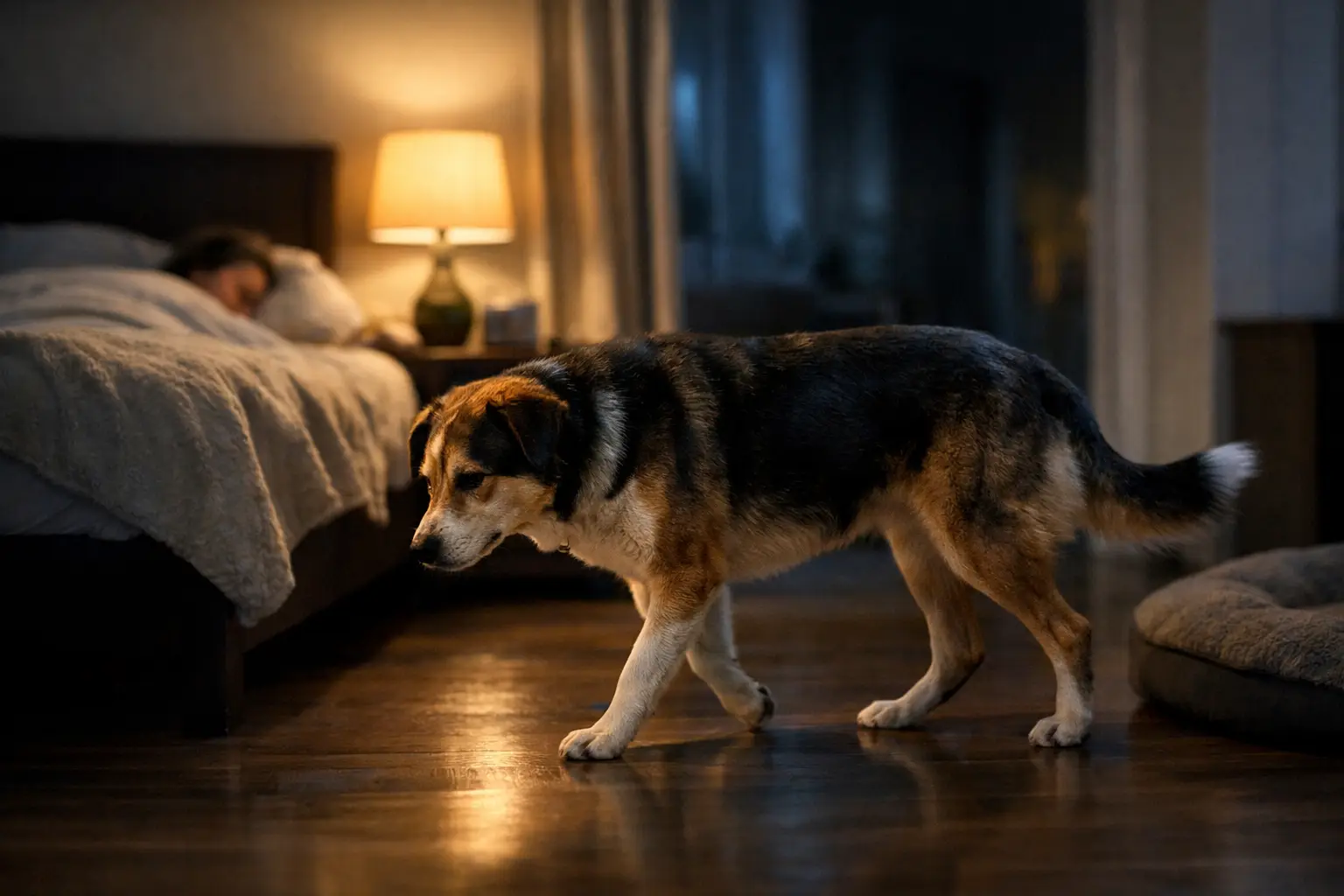
At 11 p.m., when the house is finally quiet, your dog starts circling the hallway, walking from room to room, or standing up every few minutes instead of settling. If you’re asking, why is my dog pacing at night, the answer usually falls into one of two buckets: your dog is uncomfortable, or your dog is too activated to switch off.
That distinction matters. Night pacing is not one single behavior problem. Sometimes it points to stress, age-related confusion, pain, digestive upset, or a bathroom need. Other times it is part of a bigger pattern of evening overstimulation, where the body is tired but the nervous system is still running high. The goal is not just to stop the pacing. The goal is to figure out what is driving it so you can respond in a way that actually helps.
Why is my dog pacing at night? Start with the pattern
Before you assume it is behavioral, look at the full picture. A dog who paces only on stormy nights is very different from a dog who paces every night after a chaotic evening. A senior dog who seems lost in familiar rooms is different from a young dog who gets a burst of energy at 9 p.m. The pacing may look similar, but the cause and the next step are not the same.
Start by noticing when it happens, how long it lasts, and what comes right before it. Does your dog pace after dinner, after guests leave, after a late walk, or only when the house goes dark? Does your dog also pant, whine, scratch at the door, stare into space, or seem unable to lie down? Those details help separate a training issue from a medical one.
Common reasons dogs pace at night
One of the most common causes is physical discomfort. Dogs who are dealing with joint pain, muscle soreness, arthritis, digestive upset, or the need to urinate may struggle to settle. You may see repeated standing and lying down, hesitation before getting comfortable, or pacing that seems slow and restless rather than frantic. In these cases, your dog is not being difficult. Your dog may be trying to manage discomfort without any clear way to communicate it.
Anxiety is another major factor. Some dogs become more unsettled at night because the environment changes. The house gets quieter, shadows shift, outside sounds stand out more, and there is less activity to focus on. Dogs with noise sensitivity, separation-related stress, or generalized anxiety can become hyperaware in those quieter hours. Pacing may come with panting, scanning windows, clinginess, or an inability to stay in one place.
Overstimulation is also common, especially in busy households. A lot of dogs do not need more excitement in the evening. They need help coming down from the day. If the evening includes rough play, a stimulating walk, constant household movement, doorbell activity, or inconsistent routines, some dogs stay aroused long after the activity ends. They look tired, but their behavior says otherwise. Pacing becomes the overflow.
For senior dogs, cognitive changes are worth considering. Older dogs can develop confusion that shows up most clearly at night. You may notice pacing, staring at walls, getting stuck in corners, vocalizing, or seeming unsure about where to settle. This does not always happen suddenly. Sometimes it builds slowly, and owners first notice it as a sleep issue.
There are also cases where pacing points to a more urgent medical concern. Pain, bloat, neurological issues, heart problems, or severe digestive distress can all create nighttime restlessness. If the behavior is sudden, intense, or paired with signs like drooling, retching, a swollen abdomen, collapse, disorientation, or labored breathing, that moves out of the training category and into veterinary territory quickly.
When nighttime pacing is a medical issue
If you are wondering why is my dog pacing at night and the behavior is new, your first question should be whether your dog seems physically well. Behavioral changes are often one of the earliest signs that something is off.
Call your vet promptly if your dog is pacing and also panting heavily without exertion, refusing food, vomiting, having diarrhea, struggling to lie down, crying out, or acting disoriented. The same goes for any senior dog with a noticeable change in nighttime behavior. You do not need to wait until it becomes severe to ask questions.
A medical check matters because training cannot solve pain. It also helps you avoid wasting weeks on management strategies when your dog actually needs treatment, medication adjustment, or a workup for age-related changes.
When nighttime pacing is an arousal problem
Once medical causes are ruled out, pacing often comes back to regulation. Many dogs do not know how to shift from activity into recovery, especially if the household rhythm is inconsistent or if the dog spends the day moving between stimulation spikes and boredom.
This is where owners get stuck. They see the pacing and try to tire the dog out more. Sometimes that works for a dog who simply needs a bathroom break or a bit more daytime exercise. But for an already over-aroused dog, more stimulation at night can make the problem worse. You end up with a dog who is physically spent but mentally buzzing.
A better question is not, how do I stop the pacing right now? It is, what is teaching my dog to settle before the pacing starts?
What to do tonight if your dog won’t settle
First, lower the load. Keep lights soft, voices low, and movement around the house predictable. Skip late roughhousing and avoid exciting games that push your dog up right before bed. If your dog may need to go out, offer a calm, boring potty break instead of a stimulating adventure.
Then watch your dog’s body language. If your dog is moving with purpose toward the door, whining, or sniffing, a bathroom need may be the issue. If your dog keeps trying to lie down and popping back up, discomfort may be more likely. If your dog is alert, scanning, panting, and unable to disengage, think stress or overstimulation.
You do not need to overcomplicate your response. Calm environment, brief observation, and a simple next step are usually more useful than constantly redirecting, talking, or offering random treats every time your dog gets up. Too much interaction can accidentally keep the cycle going.
Build an evening routine that reduces pacing
Dogs settle better when the evening has a clear rhythm. That does not mean a perfect household or a rigid schedule down to the minute. It means the dog can predict the flow from activity into downtime.
Start with a consistent final potty break and a repeatable transition into rest. This might look like water offered at the usual time, lights dimmed, TV volume reduced, and one quiet settling routine in the same location each night. The routine matters because predictability lowers decision-making and uncertainty.
It also helps to stop treating calm as an accident. If your dog always gets attention for excitement and very little guidance for recovery, pacing is not surprising. Notice the small moments when your dog pauses, softens, or chooses stillness. That is where structured reinforcement becomes useful. At Rubyjo K9, we teach calm through simple repeatable loops because most household dogs do better with a clear pattern than with endless corrections after they are already wound up.
What not to do
Do not assume every pacing episode means your dog needs more exercise. Many dogs need better regulation, not just more output. Do not scold your dog for being restless. If your dog is anxious, uncomfortable, or dysregulated, punishment adds pressure without solving the cause.
It is also wise not to chase quick fixes. New supplements, constant entertainment, or changing the sleeping setup every night can muddy the picture. If you change five things at once, you will not know what helped.
A simple way to track what’s happening
If the pacing has been going on for more than a few nights, keep notes for one week. Record the time it starts, what happened in the two hours before bed, whether your dog ate normally, whether there were bathroom changes, and how long it took your dog to settle. Patterns show up fast when you write them down.
This kind of tracking is especially helpful for busy owners because it turns a vague stress point into something measurable. You are no longer dealing with a feeling of chaos. You are looking at a repeatable behavior in a repeatable context, which gives you a much better shot at changing it.
If your dog is pacing at night, take it seriously, but do not panic. Restlessness is information. Sometimes it is your dog asking for medical help. Sometimes it is your dog showing you that the day never properly came down. Either way, the path forward is the same: notice the pattern, reduce the noise, and respond with calm structure instead of guesswork.
Safety note
Safety note: if your dog shows aggression, intense fear, bite risk, pain, sudden behavior change, or medical concerns, contact a qualified professional or veterinarian before pushing the routine harder. This article is educational and is not a substitute for individualized behavior or veterinary care.