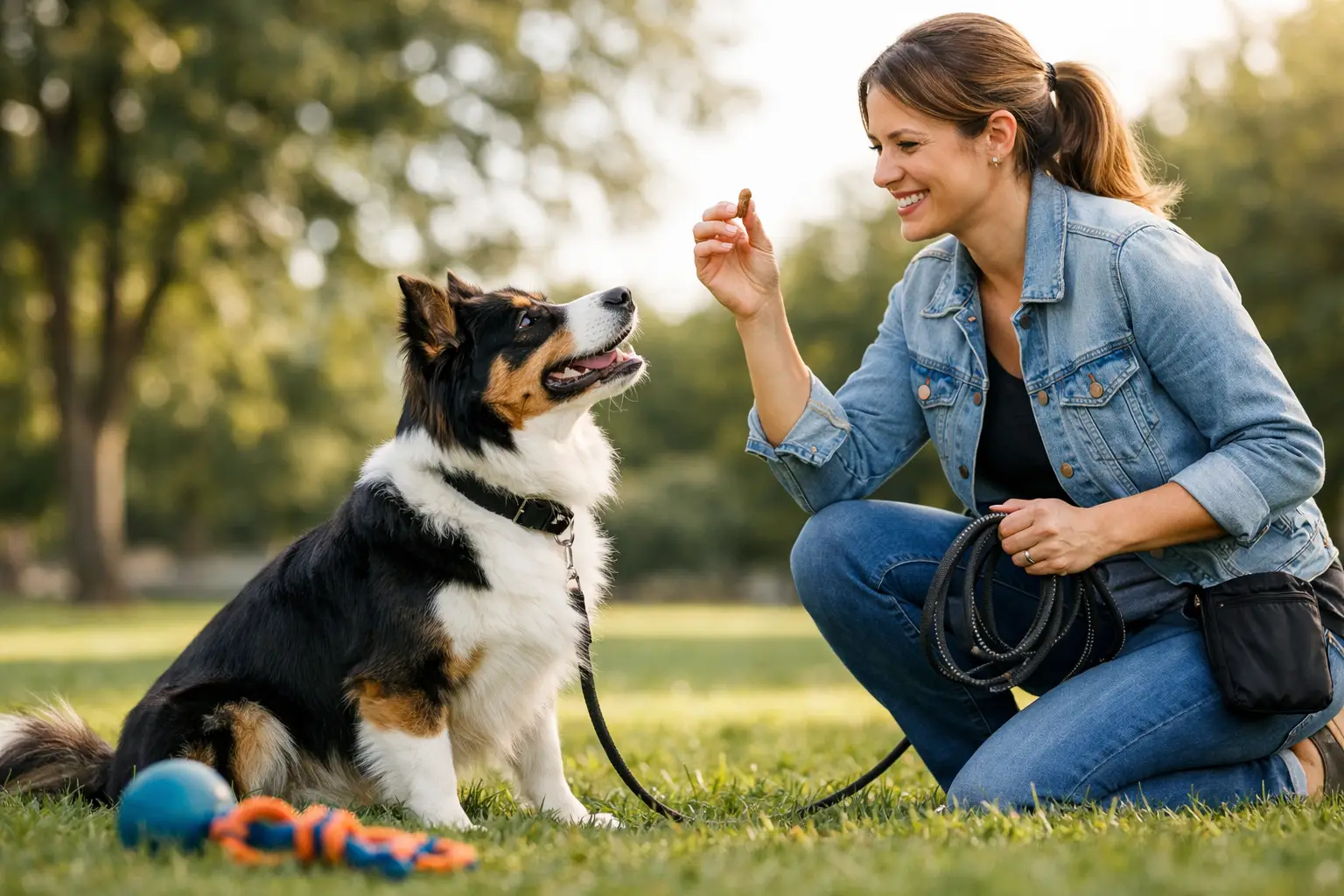
If your dog loses it at the doorbell, turns every walk into a launch sequence, or paces the house like the day never ends, the problem usually is not that you need more training tricks. You need a reward based dog training routine that your dog can predict and you can actually repeat when life is busy.
That matters more than most owners realize. Dogs do not get calmer because we want calm badly enough. They get calmer because calm becomes practiced, reinforced, and easier to repeat in the exact moments where chaos used to take over. A good routine gives your dog that practice without asking you to spend an hour a day running drills in your living room.
What a reward based dog training routine really means
A lot of people hear reward-based training and think treats. Treats matter, but the routine is the part that changes behavior. Reward-based training works best when the dog learns a clear pattern: notice the trigger, reset the body, earn reinforcement for a better choice, then return to normal life.
That sequence keeps training grounded in real situations. Instead of waiting for your dog to explode and then trying to manage the fallout, you start teaching what happens before the barking, pulling, spinning, or jumping takes off. You are not bribing your dog through bad behavior. You are paying for behavior you want repeated.
This is also where owners get stuck. They reward randomly, practice inconsistently, or only train when things are already going badly. Then it feels like the dog knows the behavior in the kitchen but forgets it at the front door. The issue usually is not stubbornness. It is a routine problem.
Why routine beats intensity
Busy owners often assume progress requires longer sessions. Usually, the opposite is true. Household dogs improve faster with shorter, repeatable practice tied to predictable moments in the day.
A five-minute routine before a walk can do more for leash manners than one long weekend session. A calm greeting setup before guests arrive can do more for jumping than ten scattered attempts to correct it after the fact. Repetition in the real context matters.
The trade-off is that routine feels less dramatic. It is not exciting. It will not look like a transformation by tomorrow afternoon. But it is sustainable, and sustainable is what changes daily behavior.
The four-part routine to use every day
The simplest reward based dog training routine follows one loop: Notice, Reset, Reward, Release.
Notice
Your job is to catch the moment before your dog tips over threshold. That might be the second your dog hears keys, sees a person pass the window, or starts vibrating at the sight of the leash. If you wait for full barking, full lunging, or full body slamming, you are late.
Notice means observing early signs: ears forward, weight shift, staring, pacing, whining, scanning, or breath holding. Those small changes are useful. They tell you training can still happen.
Reset
Reset is the action that interrupts escalation and brings your dog back into a state where learning is possible. For one dog, that might be turning away from the window and moving to a mat. For another, it could be backing up from the front door, pausing, and waiting for four paws on the floor. On walks, it may be a simple stop, hand target, or reorientation back to you.
The reset should be easy enough that your dog can succeed quickly. This is not the time to ask for a perfect heel, a long down-stay, or anything beyond your dog's current skill level. You are trying to lower arousal first.
Reward
Reward the behavior that shows your dog is making a better choice. That could be eye contact, a softer body, standing still, disengaging from the trigger, or moving with you instead of against you. The reward needs to come fast enough that your dog understands exactly what worked.
Food is usually the clearest option because it is precise and repeatable. Praise can support it, but praise alone often is not enough when the environment is more exciting than you are. If your dog is very aroused, use rewards that are easy to deliver and high enough in value to matter.
Release
Release is where many owners accidentally create frustration. After your dog makes a good choice, life has to continue. That may mean going through the door, greeting the guest more calmly, resuming the walk, or returning to normal activity.
Release teaches your dog that calm behavior does not end the fun. It is what gets access to the next thing.
How to build the routine into real life
The easiest way to fail with dog training is to make it separate from your actual day. The easiest way to keep going is to attach practice to moments that already happen.
Pick two or three daily pressure points. For most households, those are pre-walk excitement, door greetings, and evening overstimulation. Start there instead of trying to fix everything at once.
Before each walk, pause for one minute. If your dog crowds, spins, or vocalizes when the leash appears, do not rush forward. Notice the arousal, reset with stillness or a known position, reward a calmer body, then release by clipping the leash on and moving toward the door. If excitement spikes again, repeat the loop. You are teaching that the walk starts through calm, not chaos. For more on this, see our guide on fixing pre-walk excitement.
At the front door, rehearse when nothing important is happening. Touch the handle, notice your dog's response, reset away from the door if needed, reward stillness or orientation to you, then release by opening and closing the door. This is cleaner than waiting until a delivery driver is already outside and your dog is screaming. Read more about stopping doorbell barking.
In the evening, many dogs get noisy and restless because they are tired, overstimulated, or expecting random activity. That is a good time for a short calm routine: settle on a mat, reward breathing and stillness, release after a brief pause, then repeat. You are not forcing your dog to shut down. You are helping the nervous system practice coming down. See our evening overstimulation guide for more.
What to reward and what not to rush
Owners often ask whether they are rewarding too much. Early on, you probably are not. If your dog is learning a new pattern around a hard trigger, frequent reinforcement makes sense.
What you do want to avoid is rewarding after the dog has already rehearsed the full unwanted behavior for ten seconds. Timing matters. So does criteria. Reward the first useful choice you see, even if it looks small. A head turn away from the window can be the first step. Silence for two seconds can be the first step. Four paws on the floor for one beat can be the first step.
Then raise criteria gradually. If you move too fast, you get frustration. If you stay too easy forever, you get a dog who only offers partial effort. Progress usually looks like tiny improvements stacked close together.
When a reward based dog training routine feels like it is not working
Sometimes the routine is sound, but the setup is too hard. If your dog cannot take food, cannot orient to you, or goes from zero to one hundred instantly, the trigger may be too intense or too close. Create more distance, lower the duration, or practice with a milder version first.
Sometimes the issue is inconsistency between family members. If one person waits for calm at the door and another opens it while the dog is mid-jump, the dog is getting mixed information. The routine needs to be simple enough that everyone can follow it.
And sometimes progress is real but subtle. The barking starts later. Recovery happens faster. The leash goes on with less spinning. Those changes count. Household behavior often improves in reduced intensity before it disappears entirely.
That is one reason systems like Rubyjo K9 focus on short, trackable repetitions instead of random tips. Measured progress keeps owners from quitting right before the routine starts paying off.
A simple weekly plan
For the first week, keep your focus narrow. Choose one trigger, one reset behavior, and one reward you can deliver quickly. Practice in three to five short reps once or twice a day. Write down what happened. Not a full diary, just enough to notice whether your dog stayed under threshold, needed extra distance, or recovered faster than yesterday. The Rubyjo K9 progress tracker can help with this.
By week two, you can start using the same loop in a second context. The benefit of a repeatable routine is that your dog begins to recognize the pattern. The trigger changes, but the structure stays familiar. That lowers confusion for both of you.
There will still be messy days. Poor sleep, visitors, schedule changes, and accumulated excitement can all affect behavior. That does not mean the routine failed. It means your dog is a living animal, not a machine. On those days, make the task easier, pay well for small wins, and protect the habit of practicing.
Calmer behavior at home is rarely built through one perfect training session. It is built through dozens of ordinary moments where your dog learns that noticing, resetting, and choosing calm reliably leads somewhere good.
FAQ
How long does it take for a reward based dog training routine to work?
Most owners notice improvement within the first week if they practice consistently at two or three daily pressure points. Harder triggers like doorbell barking or guest greetings may take two to three weeks before the dog reliably offers calm behavior on the first rep. Progress is measured in reduced intensity before it appears as full elimination of the behavior.
What if my dog only listens when I have treats?
That is normal in the early phase. The reward teaches the dog which behavior to repeat. As the routine becomes familiar and calm behavior starts paying off naturally (the walk happens faster, guests greet sooner, the door opens), you can phase treats into an occasional schedule. If the dog regresses, increase reward frequency again and phase out more slowly.
Can I use this routine with a dog who has fear or anxiety?
Yes, with adjustments. For fearful or anxious dogs, keep the trigger at a greater distance, use higher-value rewards, and end the session before the dog tips over threshold. If your dog shows intense fear, freezing, shutting down, or redirected biting, consult a certified force-free trainer or veterinary behaviorist before pushing the routine. Safety comes first.
How do I get my family to follow the same routine?
Keep the routine simple enough that everyone can remember it. The Notice-Reset-Reward-Release loop takes about thirty seconds per rep. Walk each family member through one practice scenario with no trigger present, then one with a mild trigger. Write the three steps on a sticky note near the front door if needed. Consistency across people matters more than perfect timing from one person.
What counts as a reward besides food?
Food is clearest early on, but you can also reward with access: opening the door after stillness, releasing to greet a guest after four paws on the floor, continuing the walk after reorienting to you. Play can work for some dogs, but keep it brief — long play sessions can raise arousal back up. The key is that the reward is something the dog actually wants and you can deliver within one to two seconds of the correct behavior.
Safety note
If your dog shows aggression, intense fear, bite risk, pain, sudden behavior change, or medical concerns, contact a qualified professional or veterinarian before pushing the routine harder. This article is educational and is not a substitute for individualized behavior or veterinary care.