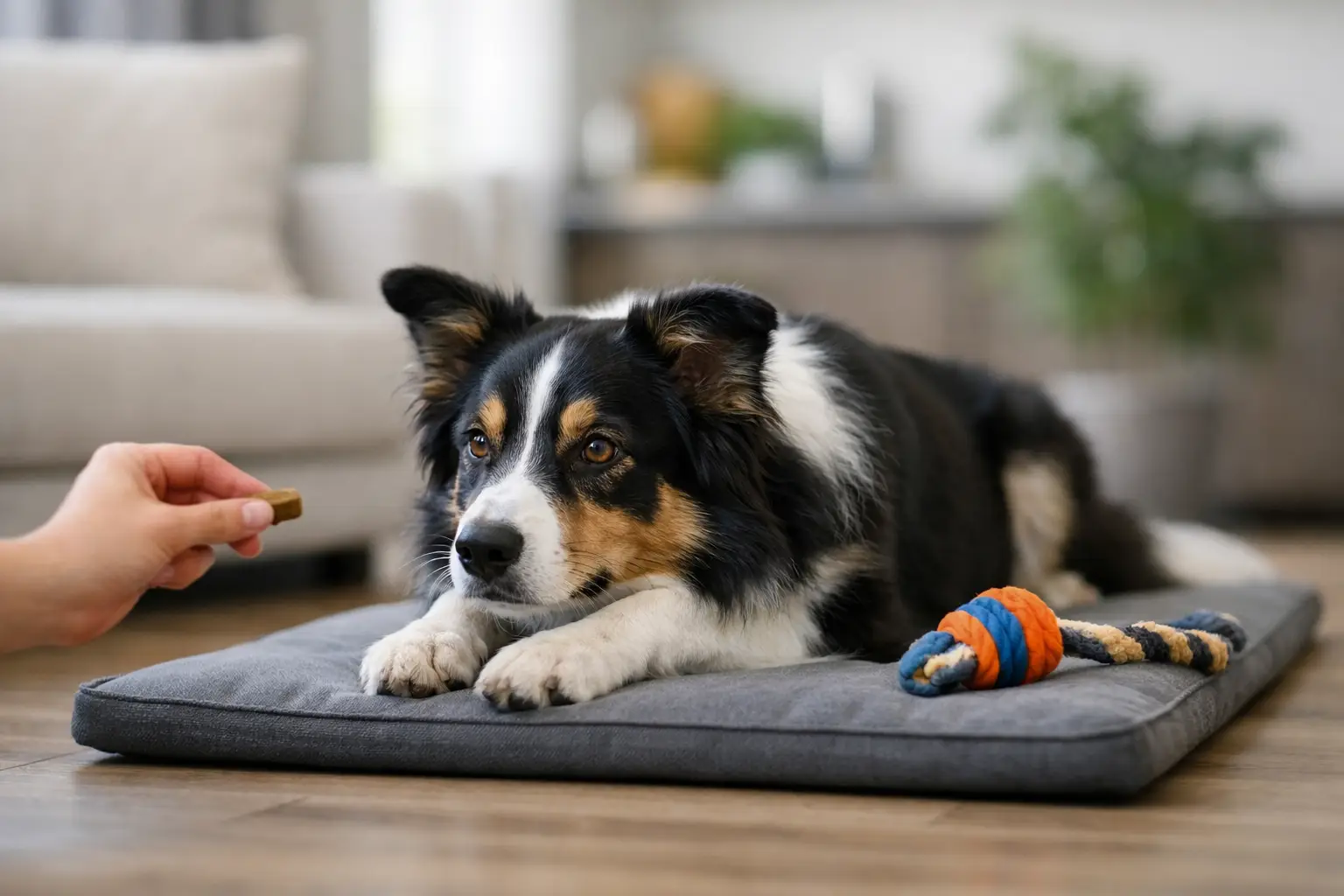
The moment your dog hears the doorbell, launches toward the entry, and forgets every skill they seemed to have five minutes earlier, you do not need a longer training session. You need a better pattern. If you want to build dog mat routine habits that hold up in real life, the goal is not to make the mat magical. The goal is to teach your dog that settling on that spot is the clearest, easiest path through exciting moments at home.
A mat routine works because it gives the dog a job before chaos takes over. Instead of correcting barking after it starts or trying to talk your dog down when they are already over threshold, you are building a predictable sequence. Dog notices a trigger, dog resets to the mat, dog gets rewarded, dog is released when calm. That simple loop is what turns a piece of fabric on the floor into a reliable household skill.
Why a mat routine changes more than one behavior
Most owners start mat training because they want one thing fixed. Usually it is jumping on guests, barking at the door, pacing during dinner, or losing their mind before walks. What they often find is that the mat helps with all of it.
That is because the mat is not just a place command. It is a regulation routine. Your dog learns how to pause, stay in one spot, and come down from arousal without needing constant physical management. For busy households, that matters more than flashy obedience.
There is a trade-off here. A mat routine will not replace leash skills, guest greeting practice, or trigger exposure work on its own. It is not a shortcut around training. What it does is create a repeatable foundation that makes those other situations easier to handle.
Before you build a dog mat routine, set it up right
Start with a mat that is obvious and consistent. It does not need to be expensive. A bath mat, small bed, or folded blanket can work as long as it stays put and is used only for this routine in the early stages.
Placement matters. Pick a spot with enough distance from the main trigger that your dog can still think. If the front door is the problem, the mat should not be pressed right against the entryway. If the evening witching hour hits in the living room, place the mat where your dog can settle without being in the middle of foot traffic.
Rewards matter too. Dry kibble may be enough for some dogs in a quiet room. It is usually not enough when the kids come in, dinner is cooking, or the delivery driver shows up. Use food your dog actually values, especially while the routine is new.
Keep your expectations realistic. In the beginning, the mat is a training station, not a parking spot for an hour. If your dog can stay calm there for ten seconds around a mild trigger, that is useful progress.
The fastest way to build dog mat routine success
Start when nothing exciting is happening.
Bring your dog to the mat and reward any interest in it. A glance, step toward it, one paw on it, then two paws. You are not waiting for perfection. You are showing your dog that this location pays.
Once your dog is intentionally stepping onto the mat, begin rewarding on the mat, low and calm. This is not the moment for fast hand motions, excited praise, or rapid-fire repetition that ramps the dog up. You want the mat to predict settling, not a party.
When your dog is comfortable standing there, wait for a small drop in energy. A pause. A sit. A hip shift. A down. Reward that. Then reward again for staying. Then release your dog off the mat with a simple cue.
That last part matters. Release is part of the routine. If the dog never knows when they are done, they often start breaking position early or become restless. The pattern is clearer when the mat has an ending.
Think of the sequence like this: notice the mat, move to it, settle, earn reinforcement, then leave when released. That is the loop you will repeat until it becomes familiar.
Add duration before you add chaos
A common mistake is testing the routine too early. Owners get two decent reps in the kitchen, then try it during a full-volume doorbell moment. That usually falls apart, not because the dog cannot learn it, but because the jump was too big.
Build duration first. Reward your dog for staying on the mat for a few seconds, then a few more. Vary it slightly so your dog does not start guessing the exact moment they can pop up. Keep sessions short enough that success is still easy to find.
Then add light movement. Take one step away and return to reward. Sit in a chair. Walk past the mat. Open a cabinet. Pick up your keys. Each small change teaches your dog that staying settled is still the right answer even when the environment shifts.
If your dog gets up, do not turn it into a battle. Reset calmly. Bring them back, lower the difficulty, and pay faster. That gives you cleaner learning than repeating the cue louder or trying to out-stubborn your dog.
Put the mat routine where real life happens
Once the behavior is stable in calm moments, start using it around the situations that actually matter in your home.
For door chaos, practice before real guests arrive. Knock softly on a wall, cue the mat, reward, release. Then increase the realism with louder knocks, opening the door, or having one family member step in and out. If your dog starts barking or leaves the mat immediately, the setup is too hard. Reduce intensity and rebuild.
For pre-walk overexcitement, place the mat near where you handle the leash and shoes. Ask for the mat routine before the leash comes out, reward calm, then pick up the leash. If the dog explodes, pause, reset, and wait for the dog to return to the mat before the walk continues. Over time, the mat becomes the starting line for calmer departures.
For evening overstimulation, use the mat before your dog tips into frantic pacing, nipping, or demand barking. This is one of those it-depends moments. Some dogs need the mat routine paired with a chew or lick item. Some need the room quieter. Some need a shorter, earlier session before they are too wound up to settle. Timing matters as much as technique.
What to do when progress feels uneven
Mat work often improves in waves, not in a straight line. Your dog may look solid for three days, then struggle on day four. That does not mean the routine is failing.
Look at the variables. Was the trigger stronger? Was your dog tired, underexercised, or already keyed up? Did you wait too long to start the routine? Did you ask for too much duration with too little reinforcement? These details shape the outcome.
If the dog keeps breaking, shorten the task. If they rush to the mat but cannot relax, reward lower-energy body language instead of just position. If they only succeed when food is visible, practice delivering rewards after they choose the mat rather than luring them there every time.
The point is not to make the dog stay on a mat no matter what. The point is to build a repeatable regulation skill that still works when life is noisy, messy, and imperfect.
The mat is not the goal. Calm recovery is.
This is where many owners get stuck. They focus on whether the dog touched the mat, lay down fast enough, or held position for a set amount of time. Those details matter, but they are not the whole picture.
What you really want is a dog that can recover. A dog that hears a sound, sees movement, feels that first spike of excitement, and has a familiar path back to calm. The mat helps organize that recovery because it is visible, concrete, and easy for the owner to repeat.
That is also why short daily reps work better than occasional marathon sessions. Five useful repetitions across normal life will usually beat one long session your dog never sees again until next weekend. Consistency builds fluency.
At Rubyjo K9, that is the difference between random training and a household routine. One clear pattern, practiced often enough that both you and your dog know what happens next.
If your home feels chaotic right now, start smaller than you think you need to. One mat. One room. One trigger level your dog can handle. Calm does not come from doing more at once. It comes from repeating the right sequence until it becomes your dog’s default.
Safety note
Safety note: if your dog shows aggression, intense fear, bite risk, pain, sudden behavior change, or medical concerns, contact a qualified professional or veterinarian before pushing the routine harder. This article is educational and is not a substitute for individualized behavior or veterinary care.