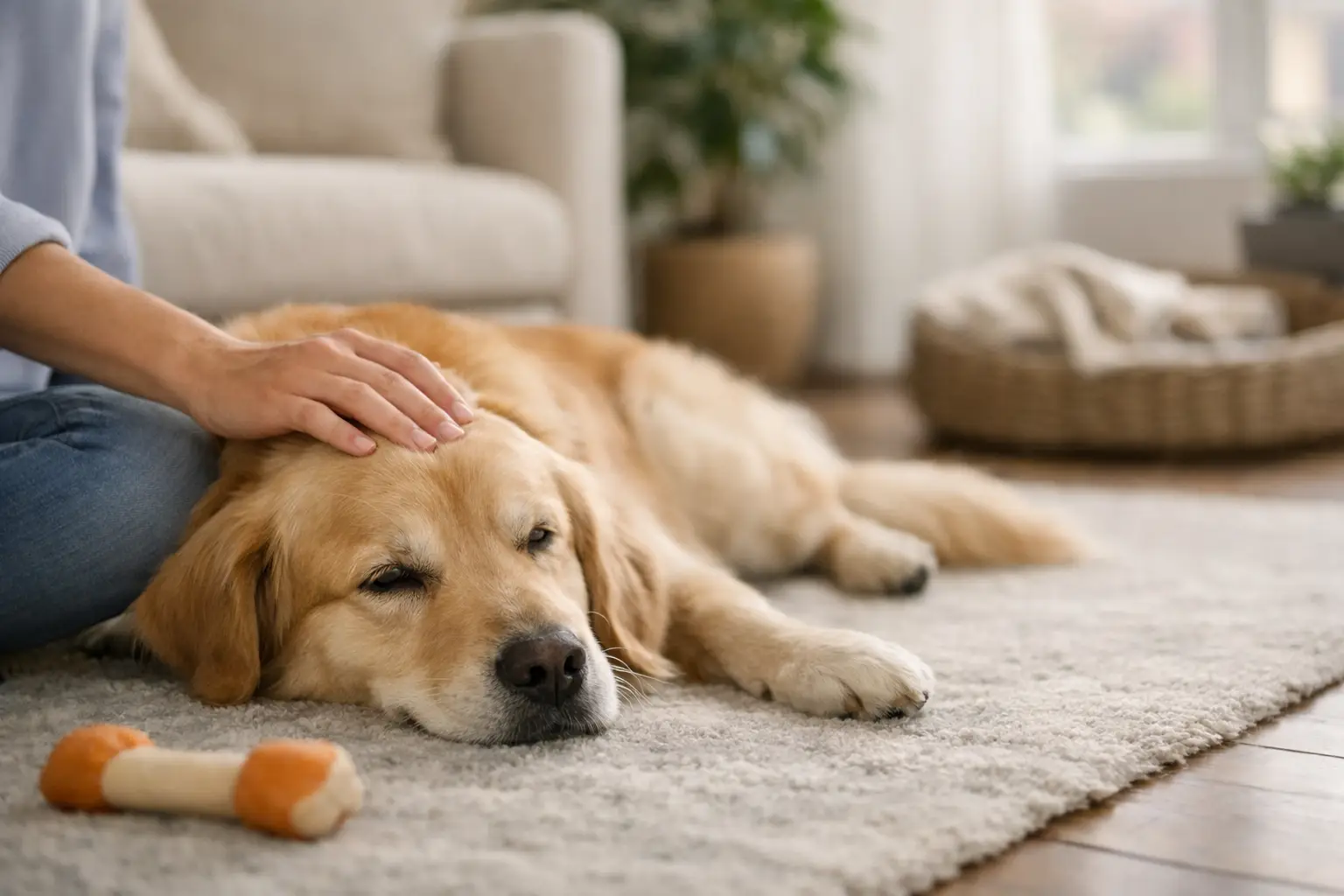
If your dog can settle for ten seconds and then pops back up at the smallest sound, you do not have a "bad" dog. You have a dog who has practiced staying alert indoors more than resting indoors. That matters, because when people try to teach dog to relax indoors, they often wait for calm to appear on its own. In most homes, it does not. Calm needs structure, repetition, and the right timing.
Indoor relaxation is not just about getting a quieter evening. It affects barking at windows, doorbell chaos, pestering for attention, pre-walk spiraling, and that wired behavior that shows up right when your day is already full. A dog who can come down emotionally inside the house has a much easier time making good choices everywhere else.
Why your dog struggles to settle inside
Most overstimulated household dogs are not choosing chaos for fun. They are responding to a home environment that keeps pulling them up in arousal. Footsteps outside, family movement, kids running, delivery sounds, kitchen activity, screens, toys, and anticipation all add up.
Some dogs also get stuck in a pattern where indoor time means one of two extremes — nothing to do, or too much excitement. They nap from exhaustion, then spike into barking, pacing, mouthing, or attention-seeking because they have never learned a middle gear. Relaxation is that middle gear.
Breed tendencies, age, sleep quality, exercise balance, and stress history all matter here. A young working-breed dog in a busy apartment will not settle the same way as an older companion dog in a quieter home. That does not mean your dog cannot improve. It means your plan should match the dog in front of you.
What "relax indoors" actually means
Relaxation is not forced stillness. It is not pinning a dog to a bed, repeating "place" for an hour, or expecting perfect calm through sheer willpower. Real indoor relaxation looks like softer body language, slower movement, fewer startle reactions, easier recovery after a trigger, and the ability to stay settled without constant management.
That distinction matters. A dog can look obedient and still be internally buzzing. If you only train position, you may get a dog who stays on a mat while staring at the window, whining, or vibrating with anticipation. Useful progress is emotional, not just physical.
Teach dog to relax indoors by changing the pattern
The fastest way to stall this training is to wait until your dog is already at a full seven or eight out of ten in excitement. By then, you are trying to stop momentum instead of shaping recovery. A better approach is to notice the early signs, reset the dog before the spiral builds, reward the calmer choice, and then release when the dog is genuinely more settled.
That rhythm is simple, but it works because it matches how dogs learn. They repeat states and behaviors that get rehearsed. If your dog practices pacing from window to couch to door every evening, that routine becomes familiar. If your dog practices noticing a trigger, pausing, settling, and getting reinforced, that can become familiar too.
Start with one calm station
Pick one place in your home where relaxation will be easiest to teach. It might be a mat in the living room, a dog bed near your desk, or a quiet corner away from the front window. Do not start in the busiest traffic lane of the house unless that is the only realistic option.
Your setup matters more than people think. If the bed is slippery, too exposed, next to a barking trigger, or placed where kids keep stepping over the dog, you are making the job harder. Good training is not just what you do with rewards. It is how cleanly you organize the environment.
Bring your dog to the calm station when they are capable of learning, not when they are already exploding. After a decompression walk, after a sniff session in the yard, or during a quieter part of the evening usually works better than the exact moment the pizza delivery arrives.
The first indoor relaxation routine
Keep the first sessions short. One to three minutes is enough. Guide your dog to the station, wait for any small sign of softening, and mark that moment with food placed calmly on the bed or mat. You are not rewarding hype. You are rewarding the exhale, the hip shift, the lowered head, the pause in scanning, or the choice to stay put for one beat longer.
If your dog stands back up right away, that is information, not failure. Reset without drama and try again. If your dog cannot stay near the station at all, lower the difficulty. Move farther from the trigger, shorten the session, or work after more decompression.
This is where many owners rush. They ask for too much duration too soon, then assume the dog "won't relax." More often, the dog has not built the skill in small enough pieces.
Reward the state, not just the position
A dog lying down with hard eyes and twitchy ears is not as settled as a dog sitting with a loose jaw and softer breathing. Watch body language closely. Rewarding the emotional state keeps the training honest.
Place treats slowly and predictably. Fast hand movements, excited praise, or tossing food can accidentally bring the dog back up. For this kind of work, calm delivery helps.
Release before your dog breaks
One of the smartest things you can do is end the rep while your dog is still successful. A quiet release after a few seconds of real settling teaches that calm does not mean being trapped forever. Over time, that makes staying relaxed easier.
Build relaxation into daily household moments
You do not need marathon training sessions. In fact, most busy owners get better results by attaching this work to moments that already happen every day. This is the same principle behind a reward based dog training routine — short, repeatable practice tied to real-life moments.
Practice for two minutes while coffee brews. Use the calm station before opening the back door. Do one short reset after a walk instead of letting your dog fly into the living room at top speed. If evenings are hard, train before the usual chaos starts, not in the middle of it — a routine for overstimulated evenings can help bridge that gap.
This is one reason structured systems work better than random advice. Your dog improves through repetition in real contexts, not through one perfect session on a Saturday.
Common mistakes when you teach a dog to relax indoors
The biggest mistake is over-exercising an overstimulated dog and assuming that more physical output will create calm. Sometimes it helps. Sometimes it creates a fitter, more wound-up dog who still has no idea how to settle. Movement has value, but it should be paired with recovery.
Another common mistake is talking too much. Repeating cues, negotiating, or filling the room with sound often adds pressure. Quiet observation usually gives you better timing.
The third mistake is training only when things go wrong. If the only time your dog hears a settle cue is after barking, whining, or zooming, the cue gets attached to stress. Practice when the dog is close enough to calm to succeed.
When progress feels slow
Indoor relaxation training can feel almost invisible at first. You may not see a dramatic before-and-after in three days. Instead, you notice your dog recovers faster after hearing the mail truck. The pacing loop gets shorter. The evening barking starts later, or not at all. Your dog lies down without being asked once during dinner.
That is real progress.
Track those wins. If you rely on memory, you will miss them. A simple note on your phone that says "settled in 90 seconds instead of 5 minutes" is useful data. Measured progress keeps you from changing plans too soon.
If progress stalls completely, look at sleep, trigger exposure, and overall daily load. Some dogs are trying to learn relaxation while living too close to their threshold all day. In that case, the answer is not more pressure on the mat. It is a calmer plan across the whole routine — starting with a dog calmness routine at home can set a better foundation.
What to do during real-life trigger moments
When the doorbell rings or a delivery truck slams outside, do not expect polished relaxation if you have not built the pattern first. In the beginning, your job is to interrupt the spiral early, guide your dog back to a known spot or known behavior, reward the first signs of recovery, and keep the whole event as clean as possible.
This is where a simple framework helps. Notice the shift in arousal, reset before it escalates, reward the calmer choice, then release once your dog has actually come down. That sequence gives owners something concrete to do instead of reacting emotionally in the moment.
FAQ
How long does it take to teach a dog to relax indoors?
Most dogs show noticeable improvement within one to two weeks of daily short practice. Not perfect calm, but faster recovery after triggers, shorter pacing episodes, and more spontaneous settling. Duration depends on the dog's age, breed tendencies, sleep quality, and how consistent the routine is. A young working-breed dog in a busy home may take longer than an older, lower-energy dog. The key is steady, short sessions rather than occasional long ones. If you see no shift after two weeks, check whether the environment is too noisy, the sessions are too long, or the dog is too tired or too under-exercised.
Should I use a crate or a mat for indoor relaxation training?
Both can work. A crate is useful for dogs who already see it as a safe, quiet den. It naturally limits movement, which can help an overstimulated dog settle faster. A mat or bed is more flexible — you can move it to different rooms, use it in busy areas, and teach the dog to relax in the same spaces where daily life happens. Many owners start with a mat during the day and use a crate for overnight rest. The tool matters less than the training rhythm: calm setup, short sessions, calm rewards, and practice across different household moments.
What if my dog will not stay on the mat?
That is feedback, not failure. It usually means the task is too hard for where your dog is right now. Lower the difficulty — move the mat to a quieter spot, shorten the session to thirty seconds, or practice right after a walk when your dog is already tired. You can also reinforce smaller steps: reward a head turn toward the mat, one paw on it, or a brief stand on it before asking for a down. Some dogs learn faster when you build the behavior piece by piece rather than expecting the full settle position immediately.
The goal is a dog who knows how to come down
A calm home is not created by suppressing energy. It is created by teaching your dog that rest is safe, familiar, and worth repeating. Some dogs learn this quickly. Others need weeks of steady work. Either way, the process is the same — lower the intensity, reward real softness, and practice recovery often enough that it becomes part of daily life.
If your house has felt noisy, jumpy, or one trigger away from chaos, start smaller than you think you need to. One station. One short routine. One calmer repetition at a time. That is how indoor peace gets built.
Safety note
If your dog shows aggression, intense fear, bite risk, pain, sudden behavior change, or medical concerns, contact a qualified professional, such as a certified force-free trainer or veterinarian, before continuing with this training. This article is educational and is not a substitute for individualized behavior or veterinary care.